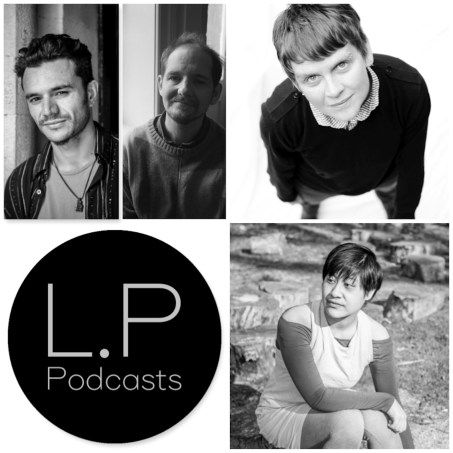
So, the last episode of the series has gone up online and what an amazing end it is. Khairani Barokka is joined by poets Raymond Antrobus, Sandra Alland and Giles L. Turnbull for a discussion about access to publishing in the UK. Link to transcript here. The quartet discuss the variety of barriers they have faced or addressed during their careers. Taking the recently published anthology, Stairs and Whispers: D/deaf and Disabled Poets Write Back, as their starting point, they move on to cover magazine submissions, live reading, poetry competitions, and the often ‘tokenistic’ approach to diversity within poetry publishing. A description of the header image, also used as the episode artwork, can be found at the bottom of this post.
This episode has been a long time in the planning and I’m just so happy that it’s happened and that it has marked the end of the Arts Council funding I received last summer. A breakdown of which can be found here.
Below are listed some excellent resources relevant to the discussion but first I wanted to list the places you can find the four wonderful guests and gigs they’ve got coming up which I just didn’t have time to squeeze into the podcast introduction…
Khairani Barokka (Okka)’s website can be found here, she can also be found on Twitter @mailbykite. Okka’s book Indigenous Species is available, in various formats, from Tilted Axis Press. Her debut, full-length, poetry collection Rope is due out with Nine Arches Press in October 2017.
Sandra Alland‘s website can be found here, and you can find Sandra on Twitter @san_alland.
Sandra and Okka, who are two of the editors of the anthology Stairs and Whispers: D/deaf and Disabled Poets Write Back, will feature, along with several anthology contributors, at Scottish Poetry Library in Edinburgh on Wednesday September 27th, from 6:30pm-9pm. Access includes: BSL interpreting, BSL content, projected text of poems, captioned films and audio description. This is a relaxed event with quiet space provided. £4/£3 concessions. More info at scottishpoetrylibrary.org.uk
You can also catch Sandra appearing on a panel as part of a film event highlighting the representation of bisexual and queer disabled experiences, for Bi Visibility Day. Visibility and Representation takes place Friday 22nd September | 6.30-9.30pm. LifeCare, Edinburgh, 2 Cheyne St, EH4 1JB. Venue wheelchair accessible via lift. Films subtitled, BSL interpreting provided.
Giles L. Turnbull‘s website can be found here. Giles can also be found hanging out on Facebook and Twitter @Bix_cool.
Giles will be reading at Putney Library on the 11th or 12th of October (date tbc, see website) as part of the extended celebrations around National Poetry Day. You can also catch Giles reading at Voices on the Bridge in Pontypridd in October and Abergavenny Writing Festival, 19-21 April 2018.
Raymond Antrobus’ website is here and he’s on Twitter @RaymondAntrobus. Ray is gigging all the time so the best thing to do is check dates on his blog or get in touch via Twitter. Raymond is the co-editor of Magma Poetry Issue 69 – The Deaf Issue due for release in November.
Resources recommended by the team behind this episode:
1. In the podcast discussion, Sandra talks briefly about research on the barriers faced by trans and/or non-binary people in further and higher education. If you’re interested in more details about some of this research being done in the UK, including about people who are trans and also disabled or D/deaf, you can follow Scotland’s TransEdu project as the research is developed. Go to www.trans.ac.uk for more information.
2. In the podcast the group discusses the excellent accessible content of the online literary magazine, Deaf Poets Society. Find it at deafpoetssociety.com
3. For people searching for audio content in publishing, San suggests an offshoot of Manchester’s Comma Press called MacGuffin. They have a website and apps that feature text and audio recordings of poetry and short stories. For details go to commapress.co.uk/digital/macguffin/
Artwork Description:

The accompanying artwork is a square image roughly divided into quarters. Everyone supplied black and white pics.
The bottom-left corner is the podcast logo, a black circle on a white background. In white lettering on the black circle is ‘L.P. Podcasts’.
The bottom-right corner is Okka, an Indonesian woman sitting on some tree trunks (in Camberwell), right arm across her knees and looking to her right deep in thought about poetry or maybe dinner (definitely dinner)! Dark-coloured, long-sleeve top under a yellow vest style dress.
Top-right corner is Sandra. The image is shot from above so Sandra is looking up and straight into the lens. White with short and medium-dark hair, eyebrow piercing above the left eye, dark jumper over a checked shirt. Trousers and boots. Walking stick in left hand. Reminiscent of Manchester-based indie band LP covers from the 90s. Photo by Tiu Makkonen.
Top-left corner is divided into two portrait-format pictures. To the left is Raymond, shot from chest up. Ray leans against the edge of a stone doorway. Short dark hair, dark shirt open over a crew neck t-shirt, pendant hanging from a leather necklace. Ray seems to be asking us to buy his latest collection or his latest pop record.
To the right of Raymond is Giles, also shot from the chest up. Giles is sat in front of the architrave surrounding a box sash window and wears a wool jumper over an open-necked shirt. All of which seems to tell us that Giles has thoroughly enjoyed this rural writing retreat and we should all join him next year when the theme is ‘Birch Trees. Nature’s Lampposts.’
End of artwork description.
Thank you again to everyone that has listened or taken part in the series in the last 12 months. It has been insightful, exciting, tiring, frustrating but mainly just brilliant. Much love, David.
Transcript:
Introduction:
DT: Hello, this is Lunar Poetry Podcasts. I’m David Turner. Hello to our regular listeners and anyone who’s tuning in for the first time. Today’s episode is the last one to come out of the funding we received last summer from Arts Council England. A big thank-you to them for the financial support over the last 12 months.
I will, incidentally, be publishing a breakdown of what the funding was used for. You’ll be able to find that over at our website from September, so if looking at spreadsheets and pie charts is something you’re interested in, then go over to http://www.lunarpoetrypodcasts.com . where you can also download a transcript of this episode, along with over 70 episodes from the archive.
After today’s episode, we’ll be returning to uploading one per month. I’m in the process of applying for more funding from Arts Council England and depending on whether that’s successful or not, I’ll be giving more details about what form the series will take as soon as possible. You can follow the progress of that application by following us at Lunar Poetry Podcasts on Facebook or Instagram and @Silent_Tongue on Twitter, though regardless of the funding application, the series will continue, as will the transcripts.
One final piece of news before I introduce the episode. The British Library has chosen to archive the entire series in their national audio collection. This is a pretty big project and will take a few months to process, but it won’t affect the way you access these podcasts. I just wanted to mention it because the archiving of podcasts is still unusual and if you lot hadn’t continued to listen, I wouldn’t have continued with the series and I wouldn’t be sitting on a series that contains over 200 poetic voices, many of them working class and/or from marginalised parts of society. I’m just made up that these voices will now be part of a national collection.
So, today’s episode. It was recorded in a space given over for free at the Albany Theatre in Deptford, South East London, by the literature organisation Spread The Word, who do fantastic work. You should check them out. Thank you in particular to Aliya and Laura for their help and advice there. We’ve spoken a lot in the last 12 months about access to the arts and literature and I thought this topic would be the perfect way to wrap up this current series, if you like.
This discussion, ‘Access to Publishing’, is hosted by poet, artist, former Lunar guest and friend of mine, Khairani Barokka, or Okka, as she likes to be known. Okka is joined by Raymond Antrobus and Giles L. Turnbull, and also Sandra Alland who, along with Okka and Daniel Sluman, co-edited an anthology of poetry and essays by D/deaf and Disabled writers called ‘Stairs and Whispers’, out through Nine Arches Press, to which Ray and Giles were both contributors.
Taking Stairs and Whispers as a starting point, the quartet go on to discuss many of the barriers that writers from marginalised groups face when trying to get published. Talking from personal experience, the discussion aims to give an overview of some of the issues faced by writers all over the UK. This of course is a starting point for further discussion and not a final statement on any subject and an hour or so is not enough time to cover everything and go into enough detail on each particular topic that came up in the discussion.
If you have any feedback or would like to get involved in the discussion yourself, then please get in touch with us via social media and our guests will engage when they have time and energy. Okka, Sandra, Ray and Giles all have gigs coming up, which I would like to plug, but that would make this intro even more rambling than it has already become. I will, however, write a blog post listing all this information, which you can find over at http://www.lunarpoetrypodcasts.com.
Alternatively, follow the link which I will post in the episode description. That’s probably enough for now. If you like what we do, please support us by telling people. Word-of-mouth recommendations, either in person or via social media, really is the most effective form of advertising for us. Support the arts and literature. Again, thank you all for listening. I can’t believe we now have over 100 episodes. I’ve really enjoyed doing this. Here’s Okka, Sandra, Raymond and Giles.
Conversation:
KB: Hello, my name is Khairani Barokka, I go by Okka, you may call me that. A while ago, David and I had a conversation about interviewing some people we respected and admired, about issues related to access to publishing. Who gets published? What are the barriers to getting published? How do people get published in different ways, and what impact that has on the form of literature, the content.
And so, I have the pleasure today of interviewing three other associates. I will be asking all three of them about their experiences and opinions related to this. So first of all – elephant in the room – all four of us have worked on a book that we’re all very proud of, called ‘Stairs and Whispers: D/deaf and Disabled Poets Write Back’, out with Nine Arches Press right now, go buy it. It was co-edited by myself, Sandra Alland and Daniel Sluman and features 54 contributors, contributing essays, films and of course poetry.
It is the first of its kind, we think. It’s probably the first major UK anthology of D/deaf and Disabled poets. We’re very proud of it, so go check it out. But this episode will not be specifically about that book, although of course it will discuss issues that we have all written about and addressed in the book, whether directly or indirectly. First of all, I’m going to ask you to introduce yourselves in your own words, what work you’ve been doing, what work you’ve got going on and why you’re interested in doing this podcast in the first place. So, maybe start with you, San.
SA: Ah, no time to think. Hi, I’m Sandra Alland, I also go by San, I’m a writer, inter-disciplinary artist and curator. My work tends to focus on creatively-accessible and intersectional arts and community organising, examining the intersections of things like sexuality, Disabled and D/deaf cultures, gender, gender diversity and variation, and then race and class.
I write and sometimes read and perform poems and short stories, I also make short documentaries, usually focusing on D/deaf and Disabled people, but not always, mostly focusing on artists, and I make a few poetry films as well, and also curate film programmes, visual-art shows and cabarets.
GT: My name’s Giles L. Turnbull. The ‘L’ is important because if you Google ‘Giles Turnbull’, there’s another Giles Turnbull whose life seems to follow a bizarrely coincidental route to mine. So I use the ‘L’. I’ve been Blind for nine years now, so I’ve written poetry as both sighted person and Blind person. My poetry doesn’t often touch on the blindness, but I often write in prose about the experience of Blindness on my poetry.
RA: My name is Raymond Antrobus, I am a poet, a teacher and a person. I was born D/deaf, my deafness has gotten progressively worse. I don’t want to use the word worse, but yeah, I have to do hearing texts every six months to make sure it’s where it’s at. I’ve only recently started writing about that, in a similar way to what Giles just said about that not always being at the forefront of what is being written about.
I’m really excited about this conversation, because I don’t think I’ve ever sat in a room where’s there’s so much- San used the word intersectionality, and there’s so much intersection here in terms of disability but also experience.
KB: And yes, I should mention that I myself identify, have been identifying for the past six years, as a Disabled woman-lady-woman. As a Disabled woman. I’m Indonesian and it wasn’t until I came to the UK that I got proper medication and accessibility for a lot of things, so this is all new and wonderful for me, it means I get to meet people like you. But yeah, writing about a past that does not involve access to what I do now, publishing and the arts, is something I am continually grappling with as well and I’m doing a PhD at Goldsmith’s about that.
So without further ado, let’s get into it. First, I would like to quote a few statistics from our friend Dave Coates, he runs the poetry review blog Dave Poems, that’s davepoems.wordpress.com, and he’s really done amazing work, researching from January 2013 to July 2017, four years’ worth of reviews from The Guardian for one, and then so many other insights that he’s got his data set from eight platforms of poetry.
With this data set, he’s discovered that articles written by people of colour are extremely under-represented in terms of overall articles. Only 4.3% of all articles written about poetry books were written by people of colour, a total of 44. The proportion of books by poets of colour reviewed is 8.1% of all books, which is still pretty shocking.
The proportion of female critics, or women critics that he’s recorded, is 41.5%, a much lower percentage for particular platforms, and likewise, the proportion of books by female or women poets that have been reviewed is 38.6%. Women critics review men and women almost evenly, but male critics, well, unsurprisingly, I’ve got to say, overwhelmingly review other men. Do better, dudes!
All of this, as he says, should remind us of just how homogenous this community has been, which for people outside poetry, they might not know, that the poetry scene is still quite homogenous. And so I think this conversation is important because we’re talking about what are the factors that lead to that, and what is changing right now, what can we do to make publishing, particularly for poetry, more inclusive and accessible, so not just talking about Disabled and D/deaf experiences, but also across gender lines.
I mean, there isn’t data here for non-binary poets, I think David has acknowledged, and for Disabled and D/deaf poets, but I’d like to hear your thoughts if you would like to go one by one and say something about what access and inclusion in publishing mean to you. I think I’d like to start with Sandra.
SA: I was thinking about what access is. It can be so many things, but it includes reducing, and ideally removing, barriers, physical and mental barriers, social barriers and that includes monetary and governmental barriers, I think we often don’t talk about those as much, and linguistic and/or communication barriers, participation in all facets of life, and then for inclusion, for me, leads on from that.
I always like to think of it as leaving no one behind, so thinking about and acting upon how to make something possible for as many people as possible. Ideally, everyone. Also, within that, destabilising power structures so that the same privileged narratives aren’t happening again and again. And then in publishing, because I thought it was interesting you asked what is publishing, so I started to think about that as well, things like books, journals, magazines, zines, chap books, online things including blogs and all of that.
I also started to think about publishing as including grant applications, applications to agents and awards, because these things often have such a huge impact on whether or not someone actually gets published in their book form, whether they’ve had access to those things as well, so they’re sort of offshoots of publishing.
KB: We’re going to come back to so many things you just said, I’m so excited that we’re getting right into the meat of things, especially as I think maybe people listening will like more clarification on the linguistic barriers that may be evident to us, but may not be evident to some listeners. Giles, if you’d like to…
GT: I always think inclusion is probably the most important thing. It happens on both fronts. You’ve got to encourage publishers to publish more of the less published writers, but you’ve also got to get more writers in those areas believing that they can publish. I first became aware of this when I looked at contemporary Blind poets and I Googled it and I found out about Homer and Milton.
I thought, ‘Is that it?’ I’m happy to say that my name now appears on a Google search like that, but there’s got to be more than that out there and I think there must be work needed, because I’m sure Blind people are writing poetry out there. They need to know that their route to publication is possible. They can do this. It isn’t, it shouldn’t be, some sort of barrier that they’re going to run up against. Working on both ends of the attack at the same time, the publishers and the writers, is important.
KB: Thank you. Ray?
RA: For me, one of the things that’s kept me going as a poet for so long is I genuinely had this belief there was nothing else I could do. I started more as a performer. I wasn’t interested in publishing anything because that’s not something I saw as available to me. I would write my stuff, I would learn it, and then I would be in front of an audience and the powerful thing about that for me, was because I was D/deaf and had so many different challenges and my confidence was really low in talking to other people, I’d lost almost every job I’d had from the ages of 16 to 20 because of my deafness and so it was kind of like, if I’m going to survive, I have to be a good poet and I have to be able to communicate with people.
It’s interesting now I’m at this point where I am publishing books, I am teaching, I am engaging with so many other people, but it’s been a journey and I do feel like I wouldn’t have had to have gone through as much had I seen more examples of D/deaf poets and more access, which is what we’re here to talk about. I hope that makes sense.
KB: It does. It really resonated with a lot of my experiences too, like not seeing examples out there, low confidence, misunderstandings, jobs. So in terms of what Sandra was talking about with linguistic challenges to publishing, I’m really interested in hearing from all three of you about how you finally broke through to a point where you felt the way you wrote was validated in a poetry world that is still largely homogenous and has been.
I’d like to start with Giles in particular, because you and I spoke earlier about how you have written as both a sighted writer and a Blind writer, but only became published as a Blind writer and I thought that was fascinating and I’d love for you to speak more about that.
GT: Yes, sure. I’ve been writing poetry since my high-school days, which is going on for 27 years now. For the most part, I was doing it for my own enjoyment. I did it as a way of relaxing after a busy day at work. But as my sight failed and I had more time, and had developed more confidence in my poetry, I decided I wanted to actually get it out there and try and get it some publications. So it’s been about five years since I’ve been published anywhere. It’s different.
I can’t comment on what it was like getting published as a sighted writer, because I never was. I guess I can imagine what it would have been. I know what difficulties I face now that I wouldn’t have faced if I was doing it sighted. Technology is usually the demon in this conversation. A lot of websites are not designed with good accessibility in mind. The easiest example is those random-word capture images that validate that you are human.
How on earth can I read that? There isn’t any kind of screen capture that will convert it into text for me. There used to be a Twitter app and I can’t even remember its name anymore, you could connect to it and say “I’ve got this capture challenge,” take a screenshot of it and then a human operator on the other end of the direct message would send the capture code back to you in text that you could paste into the box.
That was absolutely fantastic, but that’s been gone for probably five years now. There are alternatives. There’s a website called http://www.captchabegone.com, which I’ve never tried, but a lot of places these days, you will often see ‘Get an audio image’ and it will read out a set of numbers that you have to listen to and type them in as you hear them, and they are manageable, much easier than the mixed-up, slightly scrambled words that a sighted person has to deal with.
So I approve of that, but I don’t know if it really benefits the publisher, whether it really lowers the amount of spam they get, but it’s difficult, if the website’s not designed right. That’s the most obvious example, but if they’re not easy to navigate, it can take a very long time to read a whole page of a website to find information you want. If they’ve used headings correctly, that makes it easier for a blind person to jump, the screen reader will help you navigate from heading to heading, so you can find the heading you want with the submission information, but if there isn’t, you have to listen to the whole page and it’s hard work.
KB: Thank you. Ray, you were speaking about the challenges of going into poetry and not really thinking about publishing and I thought that was super-interesting. What caused the shift? Do you feel a lot more comfortable now that you’re in Poetry Review, you know that your work is validated? What was that shift?
RA: I think that shift was looking wider at the kind of poet… I think the kind of poet that I wanted to be changed. I was very much, in the first few years, about slam and about live poetry. I felt passionately about that space because again, it was something I had, I could kind of claim ownership over, without too many concerns and I think I looked at the publishing world, because I did have poetry books on my shelf, growing up, but that always just seemed like another world.
So I guess that shift might have been when I started seeing other poets who were also slamming. I started touring. I went around Germany and Switzerland, that side of Europe, and I noticed how many poets I was seeing, who are respected slam performance poets, also had books. I needed to see those examples and I think that planted something with me. Then, funnily enough, just as I was coming back, Burning Eye started and Clive from Burning Eye…
KB: The publishing house.
RA: …yeah, asked me, no one’s ever asked me before, ‘do you have anything we could publish?’ I just so happened to have been working on these… The timing was just gold. So I gave him what I had, he published it and it became a book called ‘Shapes and Disfigurements of Raymond Antrobus’. And I’m still really proud of that book, of how so many things came together, including the design, the front cover of the book, was designed by a man who’d seen me read poems, said he’d enjoyed them so much that he wanted to give something back of his own creation and ended up making this cover.
So it was just like organic collaboration. Now I’m passionate about making sure that other people who have other different kinds of challenges, including deafness, feel like they can submit, feel like they can become published poets as well as performance poets.
KB: We’re going to come back to that, because I think encouraging other poets and creating more of an inclusive community is something that’s common to all of us. I want to talk about strategies for that later, but Sandra, you’ve worked for years on multimedia, interactive, intersectional experiences. There’s so much I want to ask you about challenges to inclusion in publishing. I know a lot of your work is collaborative as well. I wanted specifically to ask about that.
SA: I’ll add a bit to what Giles was saying about barriers in terms of forms and online stuff, because I also use voice-activated software, trying to get naturally speaking, which I collaborate with! Although that’s not the kind of collaboration you were talking about… It doesn’t work with a lot of online forums as well. I think there’s been a lot of problems with things like Submittable for a lot of different programmes, and apps not working, and then the grants and awards, a lot of this is all online now and the autofill forms are not great and they don’t work with everything.
It’s also the socio-economic barriers. They’re assuming everyone is online in the first place. That’s a really huge thing, because there are so many people who aren’t. At my local library in Glasgow, there’s a queue to use the computers still. People don’t have that kind of access. Thinking about that as well. In terms of collaborations, coming back to linguistic barriers, I’ve worked with a lot of D/deaf BSL users and there’s hardly ever call-outs for magazines in BSL and there’s no information.
There’s also not audio information for people who are Blind or visually impaired, because not everyone is able to use the assisted technology or magnifying glasses or whatever, so thinking about these different ways of getting into things in terms of collaboration, it’s ensuring there are interpreters so people can have proper conversations and that sort of thing as well. Also, easy English, English that’s accessible to people with learning disabilities, that kind of thing is really important.
KB: I want to speak specifically about the process of submitting. Raymond, you had that wonderful coincidence, Kismet, of Burning Eye approaching you directly. We’ve been working with Nine Arches and Jane, who’s open to these things. I would like to ask specifically about whether you think publishers are conveying themselves as accessible and inclusive?
Sandra’s about to burst out laughing, because the process of submitting… I know you talked about Submittable. I want to speak about how publishers… for example, one thing you wrote about in ‘Stairs and Whispers’, Sandra, was this need to tour. I started out in performance as well, but it was really hard and I kept doing it because of this expectation that this is what poets do, rather than ‘how can I protect myself and do this better?’
I want to know if you think those conversations are happening more and more with publishers. If I can add one more thing, I would like to see more people in positions of power in publishing who come from different backgrounds and I want us not to only be ‘submitters’ and ‘the poets’. I want us to be publishers. That hierarchy needs to be more inclusive, I think. Are we still completely outsiders to some extent? Are publishers stating they are more amenable to, quote-unquote, ‘diversity’ – I hate that word – but you know, getting people from more socio-economic backgrounds, racial backgrounds?
SA: I would have to say no. I think people who are from the backgrounds that are being included in term ‘diversity’ are often doing this work, but I don’t think other people really are. There are amazing D/deaf and Disabled publications, Deaf Poets Society, that are doing things that are completely accessible, they’re so amazing, everything they do has audio, they’ve got it all covered.
We ensured there was a lot of access on this book, but that was from us working towards it. People aren’t just doing this, I think, a lot of the time. I think people are trying to be more open-minded about including more kinds of people, perhaps, but they’re still not doing the work to find the people and to make themselves accessible to people in general. There are exceptions, of course, but overall things are still kind of bland, I think, to be honest.
RA: Just this week, I found out a friend of mine, Sophie Woolley, who is a full D/deaf playwright-poet, she just won mentorship with Penguin Random House. There are some examples in the wider scheme of things, lots of issues, but there are some things. Even speaking for myself, I’m editing the next issue of Magma, that’s been really interesting to be on that side of the table, to be someone who’s asking for submissions and being someone reading those submissions and curating that space, with everything that we’re talking about around this table in mind. That’s interesting.
KB: So you’re co-editing it with Lisa Kelly and both of you are also in ‘Stairs and Whispers’, which is wonderful. I think the different editorial approach of allowing non-D/deaf people to write about deafness is really interesting and I want to ask you about it. Different to how Sandra, Daniel and I curated ‘Stairs and Whispers’, we wanted it very much only D/deaf and Disabled poets, writing about anything really. Can you talk a bit about how you came to that decision with Lisa?
RA: That was tricky. I think the way in which the compromise with this issue is, like you say, even with ‘Stairs and Whispers’, it’s the first time we’ve ever done this, so it’s the start of something. I can tell you that 22 of those poets are D/deaf without being published and also first-time publications. 22.
KB: Wow, out of how many?
RA: I’m not sure I can disclose yet how many. It was also very difficult dealing with rejecting a good number of poems, of writing, of material which was credible and important, but didn’t, I guess, live up to the standard of the publication, the standard they were looking for. It was challenging. I’m proud of what we’ve done, but what was really important for me, and I said this going in on this project, is that this cannot be a one-off thing.
Going forward, this needs to be a landmark in the way in which access is granted by, this one issue changes the landscape from here on. It’s ambitious. Like you say, we couldn’t take on the entire crusade as it were, it had to be like, ‘I’m going to do what I can with this one thing and begin a conversation or begin an exploration.’
KB: I think that’s all any person can be expected to do. Even if you think it’s a small thing, it’s quite impactful. To do it with heart and to do it properly is difficult, but hopefully, it will multiply. Just seeing how other people are awoken to… ‘Oh, an anthology can be multimedia, oh, there are so many D/deaf and Disabled poets writing, oh, there are trans people writing, LGBTQ people writing, there are Black-Asian minority ethnic poets writing…’
It’s funny that people seem to think we don’t exist unless something like this comes out and shows actually, there are so many of us and we have always existed. Giles, when you submit, do you feel like they’re friendly and open to the idea of, a) that you’re a Blind writer conveying your art, and b) that it’s not a charity thing to accept, that the poetry has to be a high standard?
GT: That is true and maybe it’s a reflection on the type of magazines I submit to, but I, probably 95% of the time, feel that the editors are very, very approachable. I have had some experience that they’re not, but most of the time, if I’m having trouble with submitting something, they’ll work around it with me. The bigger problem I have, well, it’s not a problem, but obviously I can’t read a printed copy and probably the number-one guidance thing that editors want is that you’ve read a copy of their magazine.
I’d like to do that, but that means I have to ask them, ‘Can I get an electronic format, ideally PDF, because then my screen reader can read it aloud?’ I know it does sometimes feel I’m kind of writing begging letters any time I want to submit something somewhere, but I’m comfortable with that. That’s the only way you can do it. I would like to encourage publishers to think about that and make their publications available in electronic format.
There are a lot of concerns about piracy, in the same way there was about mp3 files in the early days of file sharing with bands on the Napster website and things like that. Publishers do say they are aware of pdf copies of their books being shared without being purchased. That is trouble and I want to explore that and talk to publications about ways around that, because it is important, because without that, there’s no way I can read their magazines, but as I say, probably 95% of publishers, maybe even more, are happy and very quickly prepare a pdf copy.
Most of the publication process goes to pdf stage before it goes to print, so it’s no big hassle for most publishers, but they’re always really happy to work as best they can.
SA: I was thinking that when people pass things around for free, it’s often people who wouldn’t be able to buy something or wouldn’t buy it anyway, so I don’t think there’s necessarily this loss of sales that everyone feels a bit rabid about. It’s actually in some ways really good for a book to be passed along in that way. It’s the way a lot of indie musicians became known, was people passing things along and saying: ‘Hey, listen to this, hey, read this.’
It can only help the publication in the end, unless everyone’s reading it for free, which isn’t the case anymore. People still want a hard-copy book. A lot of people want a designed, e-reader, e-book, they don’t want a pdf. I don’t think it’s going to be an overwhelming thing.
GT: It’s like the whole ethos of public libraries, which are sadly in decline too.
SA: Exactly. You can all read it for free there.
KB: Libraries, yes, absolutely. So another thing I wanted to bring up is higher education and its connection to publishing and the poetry world. I know Ray went to Goldsmiths, I’m doing a PhD at Goldsmiths, I got my Masters from NYU, all not possible without scholarships, but the availability of stuff like that I want to speak to. Also, whether there’s a sort of elitism in requiring higher education, what divides and what benefits poetry in higher education has for inclusion and access.
RA: Actually, I just realised that what you just said earlier about when did I first feel able to publish something, like submit to magazines specifically, and I’d never considered it until Jack Underwood, who was my dissertation adviser, he just read some of my poetry and said: ‘Have you heard of The Rialto?’ I was like no. ‘I’m going to submit.’ He did it for me. He submitted.
There’s a picture of him in this room. That guy on the wall took my poems and submitted them to the Rialto for me. They were all rejected and he said: ‘Don’t worry, I could paste the wall with all my rejection slips. Try again.’ Second time I did it, they actually wrote back a note. They rejected it as well, but they said: ‘This is interesting. There’s something here.’ Third time I submitted, I got in.
But it was being coached into it and the fact I was coached into it, I guess from within an institution, academia, there is something to say to that because I often felt, again, that those places weren’t for me until I found myself in them through the back door. Even my route into Goldsmiths university, I didn’t even get any GCSEs, I did a whole heap of interviews and written interviews to get in, to make a case that look, I am capable of doing this work at this level.
I wrestled with it a lot. I’m someone who’s been very proud of my auto-didacticism and I felt like I’d be giving that up, going into an academic space, but now I’ve gone through it, I’m so glad I did because it challenged so many ideas I had, and myths and narratives I had about where I belong, where my work belongs. I feel like I’ve only benefitted from it.
KB: That’s wonderful. Giles, before this podcast began, we spoke about you potentially applying to an MA programme and your decision to try and go for that.
GT: I’ve never really formally studied poetry. I mean, I’ve been writing it for over 25 years now, and it’s going quite nicely, so I don’t really need an MA to boost it, but I’m in no doubt that studying, spending a year working on it, would make an impact on my poetry, it would change a little bit how I write and give me broader ideas to write about, but there are two other aspects.
Everybody always says poetry isn’t a paid job, you cannot survive. You can be a librarian, you can be an accountant, but you can’t really make money from your poetry, and that is very true. I would hope that if I studied a Masters course, it would open a few more doors into publishing kind of roles that I would not have much chance with without it. The third angle to that consideration is my blindness.
My big weakness at the moment is my independent mobility. I used to be a lot more mobile when I first lost my sight, albeit it with slightly more sight than I have now, and I want to regain that. I think that living on a university campus, getting out of my room and having to get to classes every day, into the library, interacting socially with other people, would have a huge impact in my life. So it feels like on three strands, it’s a really good thing for me to think about for this coming academic year.
KB: Good luck. Sndra?
SA: I think it’s a difficult question. There’s the socio-economic barriers, there’s people who cannot afford to go to university and there’s not enough scholarships to go around, and coming out with debts of £40,000 these days, it’s an awful lot to put into something like poetry. As well, you mentioned barriers in terms of getting around, that sort of thing, for a lot of trans people, non-binary people, there’s a lot of research being done that people are dropping out of university or not going, because of the social barriers to studying and that sort of thing.
If someone decides to transition, for example, and they have to deal with, basically, prejudice around them and changing a lot of things officially, or if they’re a trans person but nobody knows they’re a trans person, they have to show documentation that says something different than their name and their gender that’s on the documentation, these kind of things. Universities are becoming gatekeepers now and this comes into things to do with race, as well, and nationality.
They’re checking people have the right to be here, they’re checking people’s genders, they’re checking all kinds of things that are quite problematic and interfere with people being able to study. The mental-health impacts of that are huge, also the economic barriers to it. I think in terms of poetry being studied, it’s great. It’s great to see a lot more people feeling they belong in that canon as well, which is incredible.
I do think that with some creative writing programmes, although maybe it’s more on the undergrad levels, is the tendency towards sameness that’s a bit problematic, like there’s a kind of churning out of a kind of poetry that you can just go ‘oh yeah, that’s the programme you studied.’
KB: Speak more about that. What kind of sameness?
SA: Well, it depends on where they’ve studied, but a lot of the time, people are writing to please their professors. They’re writing to please a specific person, maybe just one person, or several, and in a specific way they think is the way, or the university thinks is the way. It’s the same kind of thing with acting courses and things like that. They produce a certain kind of… And you’re not maybe getting that raw writing that happens with people who haven’t been formed in the same way.
RA: That’s not exclusive to academia, that’s general.
SA: That’s true.
RA: I also think what is exclusive to the academia and that sameness is still the required reading list of poets. Really? It’s like John Berryman, yeah sure, and I’m not saying those poems don’t have anything to offer, but when it’s all, when its exclusively that…
SA: That white male canon.
KB: White male straight.
RA: That’s not changing. That’s what’s interesting to me. That’s not changing.
SA: And how often are you seeing Milton taught? Otherwise, you don’t see Nuala Watts on the reading list yet.
KB: Shout out to Nuala Watts, who’s a Blind poet.
GT: I reviewed her pamphlet a little while ago for the Sphinx website.
KB: She’s also a Stairs and Whispers contributor. This a secret marketing of Stairs and Whispers by the way, we just love our poets so much and she has a fantastic response to Milton’s sonnet on partial blindness.
SA: Again, this is the way people do get started is through Masters, people choose what they study, so that is interesting to have people like yourselves going into that kind of higher education, because then you have different projects coming out that would have normally been produced.
KB: And then you have that gendered term Masters and also the racial connotations of Masters.
RA: Can I just give one subversive thing that happened to me because this is something I’m very open about at Goldsmiths and it was welcomed. Those challenges were welcomed. In fact, I did a whole paper on Frank O’Hara and I chose Frank O’Hara because you know, everyone knows ‘Frank O’Hara’ and I’m not saying he’s not a great poet, he is a great poet, but this dissertation I wrote about Frank O’Hara was basically looking at how his poetics are different to mine, even though we both live in a city, so it’s about the poetics of the city, but it was actually my lowest-graded paper of everything I did at Goldsmiths, but in a very interesting way, a way that was helpful, because the conclusion was: ‘Raymond, Frank O’Hara is bad for you. Frank O’Hara is the equivalent of having cheese in your diet when you’re lactose-intolerant. Because the poems you’re writing, that are directly in conversation with Frank O’Hara, are your weakest poems.’
That was an actual…it was great. I was like, wow, there’s such a thing as a bad influence. Reading that is bad for me. It came from O’Hara. I still read O’Hara, there are a lot of poets I read for pleasure, but they don’t influence me. I think it’s a different thing. I enjoy them, but they don’t make me feel like writing.
KB: Wow. Absolutely. Recently, I was on a panel discussing the UK canon, white straight men, not acknowledging the fact that when you’re talking about the UK, you have to talk about Empire, you have to talk about the writing that comes from the colonies and writing from places that weren’t UK colonies but were influenced by English and it’s this whole thing of how marginal or how influential you want to keep people who are scholar-artists, who are women of colour, LGBTQI, to not be niche in university, to really influence what is going on.
I mean, the number of women-of-colour professors in the UK is shockingly tiny and I feel like seeking out those women in my life, those people whose experiences resonate with me, has been way more difficult than I thought it would be. I think it also rests on the universities themselves to empower people in higher education who are bringing an interesting quote unquote reading list that speaks to them. In high schools also.
Not just universities, we’re talking about the whole education system and going along with earlier, Sandra, you briefly mentioned nationality and one thing I want to cover briefly is the Eric Gregory Awards for poets 30 and under, recently opened to poets of all nationalities and I know myself and a few other people were ‘Aargh!’ because we’re not British, we missed it because we’re heading into the best decade of our lives, we’re in our 30s now!
I thought that was a real landmark in terms of ‘Oh, maybe things are changing’. Too late for us. But I think what you’re saying is it’s maybe not changing quickly enough, but what do you say about developments like that, when things are being opening up to all nationalities?
SA: It’s a bit different in Scotland. Things tend to be, even when we voted, did or didn’t vote for independence, it was based on residency as opposed to nationality, and not everything is that way. The Edward Morgan Poetry Award, is a similar one, under 30, but they say you have to be born in Scotland, and/or raised in Scotland, and/or a resident for two years or something like that. So you can just be living there and I think that makes a huge difference.
You don’t have to have been living there for a long period of time. But on the same hand, I looked at the list of people who’ve been nominated and most of them tend to be people who were born and raised in Scotland and the last two times they’ve done it, they seemed to be all white faces. So you can change the rules, but it takes a while before things start to filter through.
People have to see themselves, or not necessarily see themselves, but people have to feel represented in order to feel like they have a chance and if you don’t have black faces up there or if you don’t see that trans women of colour are getting awards or being nominated for getting awards, you’re going to be, should I submit? What’s the point because it’s going to be the same people? I think that’s something that can be improved from a lot of different levels, just trying to make people feel welcome.
RA: That’s the thing, because even if you do get in, you then question, like wait…
SA: Yeah, is this a diversity thing?
KB: Yeah, am I here as diversity for hire? I don’t know about you, but I have actually been approached by an editor saying: ‘Would you like to submit? We’re trying to diversify.’ I get that quite a bit and I’m like, oh, I’m so flattered, at the same time, it’s is that the only reason why you’re approaching me, because I’m a Disabled brown woman? Or is it because of the quality? When editors approach people, I think it’s also very important for editors and publishers to think, OK, what is the intention here? Why am I approaching this person? Have I read their work? Do I understand, do I respect and admire their work? Because the main thing is for the work to be recognised as quality, even if it doesn’t fit the award judges’ definition of quality.
I think there’s something our silent host David Turner mentioned in an earlier conversation with me – quietly and silently, godfather host David Turner – is this concept of nature writing and awards that privilege this bucolic, pastoral type of poetry and its relationship to race and class. I thought it was really fascinating. When you read award winners, do you think… There’s also the emotional labour that needs to happen, where you think, I’m going to try and burst through and I think my poetry is worth it, it comes down to self-confidence as well.
I want to speak about this concept of responsibility because as you have said, the people doing this work to increase inclusion and access, are largely from marginalised communities themselves. We would much prefer to be writing. I mean, I can only speak for myself, but we would much prefer to be writing and editing our own work and of course, editing is fantastic and representation work is important, but it always seems to fall to marginalised groups to do this and I struggle with this, because I don’t necessarily want to encourage students of mine, to be ‘OK, you also have to do the work of opening the road for other people’, I think that’s important but I also worry about the emotional labour that we’re expecting of young poets.
Why aren’t people in the mainstream doing more of this work? I guess my question is, do you see that as a burden?
SA: It’s a huge burden. I mean, it’s not a burden because I love to do things for my communities, but it’s a huge burden. For every event I do, I end up doing the audio description, doing the sub-titles myself, doing the stuff other people should be paying for, usually they’re funded organisations, funded publishers, this kind of thing. What I find happens is when they do actually get somebody who says ‘Hey, we’ll cover the access for you’, they’re only doing it for our event, for a D/deaf, Disabled event, they don’t keep doing it for other events.
It’s just like we’ve done this thing, we’ve done our D/dead and Disabled moment, we had the BSL interpreter, we got the photo op and then they move on and never do it again. I find that really frustrating and that puts the burden back on us again, because the next time I do an event, well, I’m going to have to pay for it, I’m going to have to do it.
KB: So much goes on behind the scenes that D/deaf Disabled people don’t even take credit for, because we have to ask, is this place accessible, is the event going to be accessible, how far do I have to walk to get there, all these things, invisible labour. I hate using the word invisible for obvious reasons, but labour that’s just not recognised. Ray, you wrote something down, I know you have something to say.
RA: Wow. My response to that is yes, but I’m going to say how I’ve managed to strategise this for myself, so it’s useful. I have a little bit of a manifesto, which is for myself. When I go into a project, including something like the Magma project, including working with D/deaf young people, trying to get them to become published poets, I’m very clear of what it is I want to get out of those experiences. I write them down and try and just focus on that.
I think OK, you’re going to get us to do extra work, someone might see you and suddenly your wires are getting crossed and you’re overwhelmed. Okka used the word emotional labour. So much of that work is giving, giving, giving and I constantly found myself coming to the end of so many different projects, with nothing to give myself. We all know that. It’s like damn, I could have written another book, that emotional labour could have gone into my own work.
That’s a real thing. I’m at this point now, I’ve got x amount of time, I’m very clear about what it is I’m going to get out of this project, how long it’s going to last and what I’m going to do afterwards. That’s something I didn’t have in place before. I do think we can only care for others if we care for ourselves.
KB: Self-care is so important and so difficult in these contexts. So much giving.
GT: I think the messages about writers from marginalised groups, almost certainly it’s going to start with the people in those marginalised groups. I think what needs to be done is the non-marginalised groups actually listen to those messages and share them so it becomes more widespread. I think that’s one of the biggest things I’m grateful for, being Blind, I’m much more aware of what’s going on in other marginalised communities.
I have written poems responding to D/deaf painters and I’ve spoken to the painters about them. I noticed the other day, there was a tweet about Pride week and I forgot who posted it, but there were about four or five LGBTQI poets’ collections. I downloaded as many books as I could find and I’m going to work my way through them and I shared that.
That’s what you need to do. It’s not my community, but I want to read that kind of work and I want other people to want to read that kind of work. I am happy to spend that time doing that. If somebody wants me to write about blindness, I pretty much do it at the drop of a hat. Maybe at the moment, I’m not overloaded with those requests. Maybe it isn’t constricting my time, but I give it my priority really, because I think it’s important the world realises that we all need to be more aware of other people’s troubles.
RA: With the Magma call-out, there was this thing that kicked off on Facebook with a bunch of American poets about the D/deaf issue call out and what this discussion on Facebook was, it was actually among a few Blind poets who said that they refuse the idea of blindness as metaphor and they were saying they felt D/deaf poets should refuse that idea of deafness as metaphor.
I understood what they were saying. I thought the policing of those ideas, of what metaphors are valid, was strange. It’s interesting you said you would write about blindness at the drop of a hat.
GT: That’s interesting because I did actually send in about four poems for that magazine, though none of them were accepted.
KB: This is a safe space.
GT: That’s not the main point. My point was that I did like that the Magma theme was open to the use of deafness as metaphor, because I wrote a poem about the unwillingness to listen, which was one of the themes suggested in the Magma page and I wrote a poem touching on blindness. Blindness and deafness have quite a close relationship.
When the house is very noisy when I’m at home, I wrote a poem about being doubly blind, because I cannot listen to the screen reader when the house is noisy, so I’m doubly inflicted by blindness because I cannot hear what the screen reader is saying. I think it’s great that the Magma thing was open to all and I’m not upset to be rejected. Magma is fiercely difficult to get into. That was my fourth attempt and I was still not successful, so I’ll keep trying.
KB: This is also a mini ‘confront your editors’ session.
SA: I think what’s important to acknowledge too is there’s such a long history of blindness specifically being used as a metaphor.
KB: In a negative way.
SA: Yeah and in a positive way, but just Blind people existing in other people’s poems and books or whatever as other people’s metaphors, or an entire book by, say Jose Saramango for example. Even just the amount of submissions you get in any publication of people saying: ‘I was blinded’. It gets boring.
KB: And ‘unheard voices’ and ‘invisible voices’, ‘the voices of the voiceless’ really get my goat. I think what’s important to recognise is that there is a multiplicity of views within the D/deaf and Disabled community. There’s a multiplicity of views within the LGBT community, among Muslims. None of these are homogenous monoliths. That’s the most important thing. I think when people say ‘the Deaf community’ or the ‘Disabled community’, these are people with widely-different views sometimes. That’s what editors need to understand.
SA: Also, it’s like D/deaf people using being D/deaf as a metaphor is much different than a hearing person using it and in terms of blindness as well, if Giles wants to write all day long about the metaphors of blindness, that’s a very different situation to me doing it.
KB: Because you’re sighted.
RA: One of the things I’ve been reacting to a lot recently is how much the news reports around Donald Trump use Donald Trump as ‘D/deaf to’. An interesting use of word there.
SA: Yeah and he’s got ‘mental-health issues’, this or that, instead of being an evil jerk.
KB: Exactly. That goes along with the use of Disabled and D/deaf people in popular media as always being evil. It’s always the Blind person or the person who has a limp, a disfigurement in some way, their existence is usually justified as being in love with an evil person or being really accomplished in some way, so this idea of the super-crip quote unquote, who has to in some way transcend their deafness and go beyond these challenges. Sometimes I see people who really use that super-crip narrative.
GT: That is one of the biggest grumbles within the Disabled community, when non-Disabled people write characters and they haven’t really bothered to get to know the sort of issues people are dealing with and how they would approach them. We see it in the TV series and film Daredevil, where a blind lawyer can hear a pin drop across the city of New York. We don’t want those kind of stories.
SA: The superpowers of smell, especially, those are big. Back to publishing, these are the things that tend to get published, whereas Disabled and D/deaf writers are not published and then we’re still carrying on the stereotypes.
KB: Or the assumption still stands we can only write about, quote unquote, differences. I personally have had ‘Ah, do you write about being disabled?’ I think: ‘I can write about unicorns, anything I want.’ Do you ask white men: ‘Do you write about being a white man?’ I want to talk about the future. How do the three of you see publishing and poetry, considering everything that we have just discussed? Are you optimistic, pessimistic, somewhere in between? Anything else you’d like to say as we wrap up?
RA: Recently, there’s been quite a change-over of editors in quite a number of major magazines and literary genres, including the Poetry Review. Just a few weeks ago, the New Yorker’s poetry editor is now Terrence Hayes, who is an incredible poet and you can’t overlook the fact he is a black man.
So Sandra said earlier about seeing a different set of people in positions of power. We are seeing that but again, we don’t yet know if this is going to have a long-term impact or is it just the season? Is it diversity season? I don’t know. I think I’m optimistic generally because I think optimism keeps me going. Pessimism doesn’t feed me so well, although I think some pessimism is healthy.
SA: I think all the poets being published in these various publications that have been happening, and that sort of thing, has got more and more people contributing, so that’s going to be more stuff. We need changes in how funding is happening in a lot of ways, in terms of budgets for access. There’s often, at least in Scotland, a section to fill out, ‘What are you going to do for access?’ and everyone lies and says they’re going to do all these things for access, then they get the money and spend it on something else.
There’s not a lot of people following up to make sure that people have the access they’ve promised, but also, putting money into that and thinking about access, you mentioned somewhere at the beginning to do with touring. Disabled people and D/deaf people especially really need extra money when it comes to that. We need taxis a lot of the time. There’s learning Disabled people, autistic people who maybe don’t want to be out in public transit, not all of them, but some of them, there’s mobility issues, that sort of thing.
Sometimes, if we’re going out of town, we need to stay an extra night, because we’ll be exhausted travelling from Scotland to somewhere, performing, going back to Scotland. I’ve been asked to do like eight-hour journeys twice in one day. It’s absurd. For anyone who’s not disabled, that’s silly. So factoring in those kind of things. One of my biggest pet peeves now that people need to factor in is paying people back their money immediately.
Poets are asked to put out so much cash to travel, spend £200 on a hotel for this night, spend £150 to take this and all your taxis and we’ll pay you back in three months. For me, that often means I can’t pay my rent if someone does that and it’s really embarrassing to say that to a publisher. It should just be a given they give you the money. A lot of the time, they already have it, it’s just not already happening. I think that’s something that needs to happen. In general, I do have optimism, yes.
There’s a lot of people doing amazing stuff, but I do think more of the work has to be taken on by non-Disabled people, by hearing people and not just in this way of ‘Look at me, I’m doing diversity’, which I think is what you referred Ray.
KB: I think a big part of that is also giving us the reins, like editorship, in terms of writing for the stage, more directors, more producers, so we can tell our own stories, rather than other people’s platforms. You know, ‘we’ll slot you in for one thing, one show’. Giles, what are your thoughts?
GT: My general mood is optimistic. We’ve made a good start, but encouraging applications and submissions from these minority groups is only part one. On the publishers’ side, they need to reach out more to the groups and say ‘look, we’ve got these opportunities we’re looking for’. If you Google ‘contemporary Blind poet’, you don’t find any entries. So are publishers wanting Disabled people and Blind people to submit to their publication saying to the RNIB ‘Can you circulate this among your members? We are holding this publication.’
We need to spread the word. If there aren’t that many people who are Blind saying they are a poet, then they probably don’t know about these events. Education is so much a major part of knowing something is out there. The number of people who are losing their sight who don’t know about the kind of technology I use every day. It would be immensely helpful to them. It beggars belief really. It’s all about communicating this message and it involves the publishers as well as the people who are in the Disabled groups.
KB: Thank you. I have two points to that. The first is I feel we should be paid as consultants for our work and actually, I have been a consultant in the past in terms of accessibility to varying degrees of follow-up. Obviously, this should happen more often, because of the emotional labour we spoke of. It’s for free. We advise people and tell people our point of view but we’re not paid for it.
SA: I get four emails a week at least from somebody asking me for free advice, how to make something accessible, and detailed free advice, like ‘would you recommend somebody who can do this or that?’
KB: You have to say ‘no’ often and tell them ‘I need to be paid for my work.’ Initially, some of my consulting stuff was ‘please give me free advice’ and I said ‘Here’s my rate’. You have to start doing that. The second thing I want to speak about is disclosure because I feel as though it’s everybody’s right to disclose or not disclose, however much detail you want about your body or what’s going on in your life or how you identify.
I want to encourage people to really be comfortable with not disclosing also. So many writers for me and I’m sure for you as well will come up and say ‘actually, I’m Disabled too, I have this problem’ and they can’t disclose because they feel it would affect their career so I feel reducing the stigma associated with disability is great. Also the right to disclose or not disclose if you want and that’s something that’s tricky.
GT: I agree with that entirely. I am one who believes in identifying as my life’s an open book. I’m happy to talk about my blindness and anything that’s related to my health. I always say ‘I am a Blind poet, I’m not a poet who happens to be blind’. I am a Blind poet. I want people to Google Blind poets and find there are Blind poets beyond Homer and Milton. I’m proud of being blind. I like the kind of person it’s made me.
I’ve just signed up, probably a very masochistic challenge, I’m doing a poetry marathon, which is writing a poem every hour for 24 hours. It starts in about two days. I signed up for it and introduced myself in the group and one lady said ‘you’re my new inspiration, my new hero’, because she’s losing her sight, so I’ve had a good discussion with her off-group about how being Blind affects your writing. I like being able to share that kind of encouragement and saying the world isn’t closed to you if you lose your sight.
KB: Absolutely wonderful and I hope people do use the word ‘inspirational’ for you. More, more, we have two minutes before we wrap up.
RA: I would definitely like to co-sign what you said about advisory. I too, on a weekly basis, get emails, very long, energy and emotionally consuming, saying ‘please help us’ but no mention of my time being worth anything. I think they mean well, but I’ve recently got to the point of being ‘look, my time has to be worth something here. That’s so important because I’m going to give you advice and you’re going to go along and hopefully it will be useful, but then how…?’
It’s so challenging because going back as well, we were talking about responsibility, because if money meant nothing, if would be yeah, have all of this advice for free that’s going to make you a better and more engaged organisation, but we’ve got to pay our rent and actually, I am giving something to your branding. I am giving something that’s going to help your brand.
SA: It’s usually someone who does have a brand. If it’s someone from the community asks, that’s an entirely situation, if they’re ‘hey, can you help me out?’ Not that I can help everyone. You give advice but when someone has money…
KB: Absolutely. I just want to say I’ve seen a call to be an accessibility consultant, ‘but we will only work with the minimum amount of budget possible to be cost-effective’. I’ve told them, ‘that is not accessible, some people need more things, taxis and interpreters, etc’ so just evolving that point of view from being cost-effective. This needs to be factored into the budget.
SA: Interpreters for social events, that’s something I wanted to say, because people always hire interpreters just to do the event and leave and D/deaf people who use BSL have no chance to interact and it’s such a big part of publishing, the social part of things, where you meet people and they say ‘hey, I’m doing this magazine and blah, blah, blah’. That sort of thing. Making sure there’s an extra half an hour, hour, there, so people can talk to each other.
RA: So something I was reminded of, I was in the States, New York, Baltimore, all of these different places, including we were talking about Deaf Poets Society and I met some of the people that run that magazine out in DC. The main thing that these organisations have are patrons and philanthropists. It’s a very different set-up for the arts in the States and so much of it is philanthropy-driven in a way. Their advice to me, I guess even to us, was ‘you need to find some patrons. Rich patrons.’
KB: Sugar daddies. This whole podcast is going to end on sugar daddies, sugar mummas, sugar gender-non-binary people. We are here. We create art. We need to pay our rents. We want to be valued as human beings in a capitalist system. Please fund us. We’re wonderful people. I would like to thank of all these people. It has been such an honour and such a blessing to be in the same room and talk to all of you.
So thank you, Giles L. Turnbull and his father John, who was here, a silent observer, he did a great job raising Giles, I just want to say, dads don’t hear that every day, come on. Sandra Alland came all the way from Scotland. Raymond Antrobus, wonderful, and David Turner, thank you so much for allowing us to hijack this podcast with some good vibes. Thank you all for listening. This has been Lunar Poetry Podcasts.
End of transcript.


 Lunar Poetry Podcasts