Arts Council Funding – a breakdown

So…. who loves pie charts and spreadsheets? Well have I got a blog post for those of you that do!

As a quick disclaimer, the following information is not intended as a guide of how to produce a podcast (I’m still trying to work that out). The intention is to encourage more transparency regarding what arts producers use public funding for and to also give a little guidance to other artists thinking about starting a similar project.

I’ve also tried to elaborate a little on what I wish I’d have done differently, either in the planning or with the spending of the funding.

My first ACE Grants For the Arts application would have been enormously easier if I’d had access to this sort of breakdown and we only get on in life by helping each other out. I hope other arts practitioners and podcast producers find the document useful, mainly so it doesn’t feel a complete waste of time! 🙂

If you want to use this information (research or study etc) then please feel free to use it but credit the source. Try not to be a dick and use this information for free if you will be making any kind of profit.

If you have any questions then get in touch and I’ll try and answer when I have the time/energy.

Follow this here link for the pie charts and percentages.

British Library

On Monday I visited the British Library in London to chat with folk from their audio department about archiving the podcast within their spoken word archive. There’s a fair bit of work to get the files into the archive but it’s all agreed and will begin very soon.

We’re all a little guilty, I think, of believing that the technology we use now (at any point in time) will be around forever but those of you that are the same age as me only need to look at that dusty pile of mini-discs you haven’t thrown away to know how quickly recording formats can become obsolete. MP3s won’t be the standard forever and it will probably be an expensive and tedious task to update the LPP archive.

Being part of the BL’s  collection means that the audio files will always be updated and accessible to the public. That is until reality is revealed to be a computer simulation and we all get access to the next level or simply switched off :).

Though, the most important part of this partnership is knowing that so many working-class voices will now be part of a national literature collection. Many of the poets I’ve spoken to since starting this series in 2014 have expressed how they don’t feel part of the poetry scene or have faced barriers in being published or even just booked for readings. I do feel like this is, partly, a validation of them as poets and the importance of their work in contemporary poetry.

As someone who failed his English Literature GCSE and has no further qualifications other than a City & Guilds Carpentry Apprenticeship to his name, it’s a little surreal that there will be over 60hrs of recordings of me speaking with writers in a national archive. Being part of this series is the best thing I’ve done professionally and I’m incredibly proud of it.

More on this as things develop. – David.


Episode 104 – Wrexham

Earlier this month Lizzy and I were in Wrexham, north Wales to record what will be episode 104, due to go online August 7th. I had a great time talking to Young Peoples’ Laureate for Wales, Sophie McKeand about her writing, recent collection Rebel Sun and  her educational work.

We also attended and interviewed Tim Humphrey-Jones and Natasha Borton about their regular poetry event, Voice Box Spoken Word which takes place on the first Monday of every month at Undegun, an arts venue in the town. The episode will also contain recordings made during the event we attended.

FullSizeRender


Series Evaluation

With only two episodes left in this current ACE funded period I’ve started to pull together some info about our audience/guests/hosts from the last three years.

I’ve already published two documents and aim to have another two up relating to this funded period of 01/09/16 – 01/09/17 by the beginning of September.

The info can be found over here: https://lunarpoetrypodcasts.com/series-evaluation/

Interview with Helen Mort – Ep.03

As we’ve recently gained a few new listeners I thought I might post a few notable episodes from the archive. This interview with Helen Mort from December, 2014 sees Helen chatting to David Turner about poetry, class, neuroscience and includes three readings from her collection Division Street (Chatto & Windus).

Download the episode here on Soundcloud. Download a transcript of this episode here or see below for the the transcript (minus poems).


download

Conversation


DT:      Hello this is the Lunar Poetry Podcast, I’m David Turner, and this month I’m in Sheffield with the wonderful Helen Mort. Just as a quick side note, because of time restrictions in the podcast my questions regarding Helen’s poetry will mainly focus on her book Division Street published by Chatto & Windus. We’re going to kick off with Helen giving us a short introduction into her work and background.


HM:     Yeah. My name’s Helen. I was born in Sheffield and then I grew up in Chesterfield, just down the road. So, I suppose growing up Sheffield was always a bit like the glamorous older sister to Chesterfield. It was a place where you went out and… Or where you were able to go on the bus on your own when you are old enough, that can place. It’s always the bright lights really. And now I live back in Sheffield again after spells being in different places, including in a year when I was poet-in-residence at the Wordsworth Trust in Cumbria and Grassmere. And where I wrote quite a lot of the poems that became my collection Division Street.


So, it’s quite interesting because I was living up in the lakes but writing all these poems about Sheffield and South Yorkshire, and Derbyshire. So, my work has always been quite informed by this particular bit of the world. So, I think it’s quite nice that we’re doing this interview in rainy Sheffield today.


DT:      It’s pretty wet, isn’t it? It does look really Northern outside.


HM:     It does, yeah.


DT:      Oh, and on that note, we’ve got a whippet in the room. Charley the whippet. It’s raining, we’re drinking tea and there’s a whippet on the sofa. I just mention that just because if you hear any strange licking noises or growling, it’s not… It’s not us. He might introduce himself.


OK, I’m going to begin with a really needlessly long anecdote about a guy I met recently in a pub in Kennington in South London. As I looked across the bar I noticed a guy wearing a t-shirt which had ‘Orgreave 84’ across the top of it. And… I don’t know, maybe he was in his in his 50s or 60s this guy. So, I went over to him and asked him about the t-shirt, if could I have a closer look. It was like one of those sort of graffiti style hooded figure who was throwing the stone which was quite apt. But… We ended up chatting about your work and your poem ‘Scab’ in particular, and Jeremy Deller‘s re-enactment, which we’ll come to you later. And he was surprised and pleased that people like us, and by that I mean people too young to have any living memory of what happened at Orgreave and other pickets, but he was pleased and surprised we still know what went on.


What I’m wondering is how much influence does your wider family’s working class background and roots have on your work, and also do you write about these subjects, I was mentioning ‘Scab’, in order to educate the unfamiliar or rather to reassure those that were involved in the picketing that those events haven’t been forgotten?


HM:     Yeah, I think it’s a bit of both and especially… That’s a really good point which is made, this idea about wanting to reassure people that things haven’t been forgotten. I’d say that’s probably the main reason, or one of the main inspirations, behind writing ‘Scab’. I actually wanted to write about it for quite a long time and everything that sort of happened to me just confirmed that. And I remember reading David Peace’s amazing book GB84 at the time when I was thinking of writing about it and I thought: Wow, he’s written about the miner’s strike brilliantly, I’d love to be able to write something myself. But I put it off for ages, I really hesitated because I felt like, as somebody that hadn’t lived through the strike myself, and as someone that didn’t have immediate family members involved in the strike, I felt like a bit of a fraud or like I didn’t have a right to write about it.


I know that there are other poets, who were involved in various ways in the strike in the 80s, that have tried to write about it and it took me ages to recognise that: Hang on a minute, that’s exactly why I should. Because I wanted to show that growing up in a bit of North East Derbyshire that was physically and… More than physically scarred by the impact of the pit closure… I remember as a kid never really understanding what all these weird land masses were just down the road from where we lived. And the words that my parents would use to describe them, I didn’t really understand it. It’s like that’s a land-fill site and that’s open casting and I’m like: What’s open casting? And it was actually very close to the village Arkwright that they moved across the road to make way for open casting after the pits had been closed. There was quite a lot of controversy about that when I was growing up.


So, all those things I wanted to show, I suppose, that the legacy lives on. And that it’s important to me just growing up with the aftermath. It’s important to lots of people, as you say, of our generation and that it’s not being forgotten at all. And it may be the fact that I wasn’t there could in some ways be a virtue and it could provide a way of writing about it that had a different perspective, and actually a bit of distance because you do get that problem sometimes don’t you that things are… And I, you know… I can’t imagine if I’d been there in some way or witnessed it first hand, I almost don’t know how you would begin to put it into words because it’s too terrible. So, in some ways I thought I’ll try.


DT:      Yeah, I suppose there’s that side of it, isn’t there? It may be it is, actually once you start, easier to write about it if you haven’t been there. Because what you’re doing is retelling stories you’ve heard, or… Not editing out things but you’re putting… It’s easier for you to put the worst things together, in a poem, because it’s not as emotional for you, whereas for a lot of people there would have…


I mean, actually going back to this guy in the pub, Johnny Eagles I think his name was, which is an amazing name. He immediately started having a blazing row with this guy who sat next to him, who was a Tory. And they… I think they had known each other for years and years but just by me mentioning Orgreave, I mean he had the t shirt on, but by me mentioning the fact to him, they immediately went back to that argument. Which they had probably had 30 years ago, you know? And it was as bitter then, so you can understand why people haven’t let go.


HM:     I think in… I’ve heard various people say to me that they don’t like the cover of my book because… I should probably describe this for the benefit of the podcasts because you can’t see it, but the book cover uses a really famous image by a wonderful photographer called Don Mcphee, which is taken from the battle Orgreave. And it’s got two policemen in their hats face to face with a miner who’s got a fake a policeman’s hat on with his NUM stickers on it and they’re squaring up to each other. And to me that epitomizes this, yeah, huge divide and the rift that’s never really been healed since that civil war in the 80s. And… Yeah, I was told it’s a bad cover because it’s going to divide people and it’s going to polarize people. I thought: Well, that’s may be appropriate in some way, I’m not sure I mind that.


DT:      But I think it’s appropriate but I also think one of the messages from that image is that image could be flipped, if you switch the hats around, if it wasn’t for his sideburns, the miner…


HM:     Yeah.


DT:      You wouldn’t nec[essarily]… You know they could be on either side, they were all men, they were probably all from the same region. They have been divided by decisions above them, haven’t they? And…


HM:     And I think that was one of the things that I find most poignant about… Or upsetting about the strike, that the communities got ripped apart by… Yeah, by things that were beyond their control in some way. Yeah, I always like that image for that reason but also because there’s something a little bit playful about it as well.


DT:      It’s quite furry as well, isn’t it?


HM:     It’s a moment that’s quite funny as well as very sad, so…


DT:      Right, so we’ll get into your other work in a moment but I’d like to focus though on this poem ‘Scab’. In the poem, you talk about going off to study at Cambridge University and the crossing of a personal picket line for you. How much of a personal conflict was your move to Cambridge from Derbyshire? And how much guilt did you feel at the time regarding the issue of cutting your roots, whether that was real or not.


HM:     I think it was… So, it’s interesting in terms of the poem that when I first started to write it none of that stuff was in there. I was just trying to write about Orgreave. And then later, because I think you mentioned [Inaudible] Jeremy Deller’s film about Orgreave, so I was trying to write about those things. It just felt like something was lacking. And it took me a while to work out what that was and I realised, it’s like well, what makes you uncomfortable about this? Why do you want to write about it?


I think often poetry does come from a sense of discomfort or an itch that you can’t scratch or just something like that. And it just came to me at one point, I’m not sure when, there wasn’t like a massive thunderbolt revelation but this realisation crept up that it was to do with my feelings of, not so much guilt maybe, but alienation and isolation that I felt when I was at university.


DT:      The word guilt is too strong.


HM:     Yeah, although maybe it isn’t. I don’t know actually, it’s certainly a kind of guilt. Because maybe the reason that guilt does strike me as an apt word is that I’ve got this really clear memory of when I found out I’d got my offer to go to Cambridge. It was close to New Year’s Eve and I was spending New Year’s Eve in [INAUDIBLE] Working Men’s Club, which is now being knocked down and they haven’t cleared the rubble away so it’s really surreal when you walk past. For a while I was living… Recently I was living quite close to it. Every day I’d walk past the rubble of this building, it was really strange.


Anyway… I was there with my friends from school and I didn’t tell anybody, I didn’t mention it to anybody, that I got this offer and that I was probably going to go to Cambridge University. And I thought I should surely… I should be really excited about that and I should be really proud about that, or something, but I wasn’t in some way. I think because I felt like in some way the people I was with were going to think that I was better than them because of that. So, I suppose there is a guilt in that way. And then when I was there, which I think is reflected in the poem, I knew it was a great opportunity for me and I really enjoyed some aspects of it. But I did feel quite… At times, quite socially isolated in a like I didn’t fit in.


And actually, it was really weird for me because I was used to… At home in Chesterfield, I was used to people at school calling me posh, and stuff like that, because I did my work and I got on with things and whatever. And then suddenly when I went away from them, I went to university I felt the opposite and I felt like I didn’t fit in with the rituals and things.


DT:      I think that’s quite a good point actually, I suppose. I mean, I’m a few years older than you but we’re the same generation as such. I found that a lot of people, of our age, that have grown up in a very working class family, feel slightly guilty maybe because we grew up in a time when you’re really not working class, even if you have that working-class background, you’ve grown up in, what essentially 20 years ago, 30 years ago, would have been a really middle class upbringing. you had plenty of toys when you were a kid and you got good education, you could go to the doctors whenever you wanted.


So, that guilt you’re being forced to leave your roots, as such, because you’re never going to be as working class as your parents. If you, you know… But if you… At the same time, you go to university you’re never going to fit into that traditional middle class or upper middle class setting either. So, you’re left flowing between and you do have that, I suppose it takes a while, to gauge what identity you’ve got. I think most people just reconcile that they are still working class in attitude and outlook on life. It might take a while to get there and I suppose as artists, whichever way you choose to work, it’s a natural process to go through to try and…


HM:     And you use your art because I suppose that’s one of the things I was trying to do in that poem in some ways. I suppose the poem’s about lots of things, but it was this sense you think: Well, what is class really and what do I feel about that? And it’s very complicated. And so the poem’s a way of saying: Well, perhaps it’s just sometimes you don’t feel like you particularly belong anywhere. but you can’t win you are sort of on both sides that in turn made me think back to, yeah, maybe more political situations and things where you also can’t win. And it’s all kind of like that, so… I don’t know that poetry ever helps you to resolve anything or get to the bottom of it. But it certainly helps you express the questions if not the answers.


DT:      Yeah, I don’t think I have ever answered anything with poetry, only confuse myself.


HM:     I do have a poem in which some students in Sheffield thought that they could work out the answers to a pub quiz from the questions in my poem. And they were really upset when they found out I’ve made up this pub quiz question, ‘We wanted the answer’, gutted.


DT:      Actually that… If we’ve got time you could go into that. I quite like that issue of truth in poetry and whether we need to tell the truth, I suppose, because I’ve noticed a lot of people get upset if they find out you’ve lied to them. A poem, which is ridiculous because if you were writing flash fiction or a novel there’s no expectation to be honest.


HM:     Absolutely and 90 percent of the time you are… you’re not lying to them, but you’re not saying exactly what happened, it’s a dramatised version of it in some ways.


DT:      Our lives are boring that’s why we write poetry.


HM:     Exactly.


DT:      Anything else other than talk about our life. Actually, that was an unintentional link into this next one. There’s a real sense of storytelling from your work. It’s almost as though with a few minor changes to the wording you could, and I mean it as a compliment, you could just be chatting in the corner of a local somewhere. I’m thinking in particular of ‘Stainless Steel’… ‘Stainless Stephen’, sorry, poem. Where there’s a blurring of the line between story and myth, quite common after a few beers. How do you feel about that assertion?


HM:     I really like that you’ve picked up on that, that’s… Because you’re never sure if people get things from your work or not. And that’s it, there’s something that I’d quite like if people did in one way. I always think… I’m very interested in pubs as… not just in general, well, I am… As a place where things happen and where everything happens. And, you know, it’s no coincidence, is it? If you watch Eastenders, or whatever, stuff always happens in the pub.


Definitely, and it really got brought home to me when I spent a year living in Grassmere in the Lake District, which is a very small village, and the pub was… If you wanted to find out anything, if you wanted to see someone, bump into them, if you wanted to know the gossip, you just went to the local pub because there’s just one really. And I suppose I have always liked the way that people do tell each other stories at the bar, and you can get talking to anyone, like you say like the guy you met in the Orgreave t-shirt.


And I actually wrote a pamphlet a few years ago called Pint for the Ghost and the idea of this pamphlet was that all the poems in it could be things… Stories that people might tell you in a pub after hours and that’s where ‘Stainless Stephen’ comes from. It’s from that in that particular pamphlet. So yeah, I think I’m interested in that because I think people’s throwaway stories are things that they say after they’ve had a few pints or whatever are really important and they’re really interesting. Sometimes more interesting than more crafted storytelling.


DT:      Yeah, but do you… Actually, going back to what we were talking about before, do you feel like you have an obligation to carry on that kind of storytelling in order to keep contact with, you know, your friends and family from your childhood. Is there a link in that way of writing that connects you?


HM:     I don’t think it’s conscious but I think it’s ingrained. Maybe I’ve just spent too much time in the pub, that’s obviously… But no, I think maybe it is on some level. Maybe you want to… I think there’s always part of you that’s trying to write poems that people that you know, perhaps all people that you care about, would understand or would be able to relate to them in some way.


DT:      I mean, I certainly feel in my writing that if, for instance, I go to the pub whenever I can on a Sunday, my uncle and his dad go religiously every Sunday and I sort of have a feeling that if they… I mean, they have no interest in reading my poetry but if they did, I would expect my writing to be clear enough for them to understand. Or to be written in a manner, not that I consciously try and change anything, but it’s just because it’s ingrained anyway it’s coming out in style.


HM:     Definitely. You get it writing… I think writing habits probably get formed quite early on, probably before you know that they have done in some ways.


DT:      I suppose once you become more comfortable with writing, I suppose then it just becomes your language anyway.


HM:     Yeah.


DT:      And you’re just speaking through the paper anyway, aren’t you? It probably comes back to how you learn to speak and talk.


HM:     This is;


Stainless Stephen

Poem can be found here

DT:      You’ve got a really… A great efficiency of language, if I can put it like that. One example I’d like to give for the listeners for context is from your poem ‘Other People’s Dreams’. You… I’ll try and do this justice, ‘Your hair is jet black for disguise. You are the photographer in your mother’s nightmare angling the camera at a door.’ And I don’t think anyone reading that could fail to connect with this simple description of the idea that one can appear in someone else’s dreams as well, inhabiting a different physical form. I suppose it comes back to what we were just talking about there, has that style of writing developed consciously? We may have just answered that actually, but…


HM:     No, I do think that’s a different question. Thinking about efficiency or paring things back. I suppose you could say that I’m really lazy as why use 3 words when you could use 1. No, I think it’s probably to do with a lot of the writers that… I suppose that I first read people like… Seamus Heaney actually was one of the first writers that I read. And then maybe later on people… I admire a lot of poets who write very differently to me, that might sound odd, so for example Raymond Carver and his poems or Bukowski, I have always really admired Bukowski. And they might sound like weird models because I don’t write anything like that in some ways. But when I think about a lot of the writers that I admire they are often quite striped back and quite, sort of…


And again, maybe it’s sort of related to trying to… Trying to be poetic of course and say things the way that sounds nice, hopefully. Whether I succeed or not is a different matter but to pay attention to sound and rhythm but also to use natural patterns of speech as much as possible. And again, you know, I can think of poems in Division Street that definitely don’t do that and they sound overly poetic. But sometimes I think, yeah, you feel like… I sort of feel like I’ve achieved what I wanted to when I’ve written something that’s conversational but also musical. That’s the ultimate aim I think for me. So, maybe it comes from the writers that I like to read and that kind of thing.


DT:      I didn’t study literature so I’m not really sure how the whole process works. But did you have any strong influences from teachers or tutors or any kind of mentors in terms of how you use your language, in the way you’re talking about now or is it just from what you were reading.


HM:     I have never really studied English either, I did psychology when I was at uni and before that my school didn’t really… I don’t mean this in a way to bad mouth it because doesn’t mean that the teaching wasn’t good but they just didn’t the scope really to focus that much on poetry. I think the poems that we used look at in school were really really old, I remember looking at Christina Rossetti and all these ballads and things like that. And Tennyson and things like that. And maybe that had some influence on me because it’s quite musical again and I’ve always been interested in music but…


Yeah, I’m not really sure. I often feel quite an impostor as a writer because I feel like having not studied English at university or anything like that, there’s all these gaps in my knowledge. there’s all these great poets that I’ve just read a bit of because I’ve tried to fill in the gaps later, or I’ve read them and frankly haven’t understood them or there’s writers I’ve still not made a proper effort with because it’s easier to read, you know, whoever it is whose work you really love and you admire and that you get that instant gratification from. So, I sometimes feel like I have not worked hard enough at reading the canon if you like. So, I suppose I couldn’t really pick out one moment from school or from higher education or anything like that that switched me on to poetry. But now have lots of helpful poet mentors who have taken me under their wing, I suppose.


There was a fantastic writer who’s just published a book called Michael Bailey who I met when I lived in Cambridge and he used to do these little workshops in his house. I would be just a couple of people that knew and him sitting round and he would just read you poems that he thought were really good. And talk about why they were really good. And a lot of that would be quite pared back, imagisitc sort of short lined stuff because that’s the style that he writes in. And so maybe that some kind of influence in the kind of thing I like.


DT:      Yeah, I often feel a little bit of a fraud myself because I’m doing a poetry podcast and I got a D at English… U at English Lit, D in English Language, I haven’t studied anything, but…


HM:     That surely makes you better qualified to judge it properly.


DT:      Maybe, yeah, but I think what you’re saying… I think a lot people find quite refreshing anyway because, you know, it’s… Poetry like all literature and all art… You should take it as you’d find it anyway. And if you like parts of it you should enjoy it and shouldn’t be forced to… I’m quite uncomfortable with this idea that you should have been well-read. About a lot of things, you know, it just to enjoy poetry because it doesn’t work you wouldn’t say to someone you must have seen every style of painting to enjoy it pointillism, or something like that. Actually, so while we are talking about education. Education or lack of or whatever, I was thinking that you work on a regular fairly or regular basis with education projects in local schools. I’ve got some questions about that but maybe you could tell us a little bit about the projects and how you got involved in them.


HM:     Well, I do all sorts really and I’ve sort of fallen into all of it by accident. I always knew from when I started writing a bit more seriously that I wanted to teach in some way, and I wanted to share my enthusiasm for poetry with other people. So, the first thing I did was I volunteered to work, no, I didn’t volunteer, I persuaded them to employ me, that’s right. Probably by pretending I knew what I was doing when I didn’t. There was a charity in Cambridge that used to work with trying to provide creative workshops for people that didn’t have access to them that often. So, I ended up working… That was my first proper job doing any kind of teaching, I was working on an estate in Huntington with a group, every week, and usually just one person turned up so it was quite dispiriting but it was a good introduction.


So, I suppose I first did adult education and then later worked for the Open University, and taught on one of their online courses. So, I’ve always done a lot of online teaching and still do. And then the schools work has happened more recently because I was lucky enough to… I applied for this great role called Derbyshire Poet Laureate which happens every two years in Derbyshire they get a new person to do it. And one of the reasons I wanted to do that was I knew it would involve a lot of schools work and I really wanted to work with primary and secondary schools, and partly because I would have loved that when I was a kid. We never had a writer come into our school and work with us. And I just thought what a great thing to do and I also thought it would be good for me and I’d learn a lot from the kids and I have so it’s worked.


DT:      Yeah. And actually, on that point, I mean, do you think that enough poets get involved with educational programs and if there aren’t why do you think that is?


HM:     I think I could imagine them being put off. I don’t know how many do. I seem to know a lot of people that work in schools with that could be the people that I know.


DT:      I guess once you start then you…


HM:     Yeah, you know more and more people that do. And it can be daunting because you do… I’ve had this feeling loads of times where you go into a school and you just think: Oh god, what… You know, they’re going to be bored by me, they’re going to hate this. Especially, I have to say, older kids and teenagers. I Really like working with 10, 11 year olds that are really responsive. It’s sometimes a bit more of a challenge when you get older. But I think everybody should because it’s such a gift to you as well as hopefully to the kids. People always get more from it than you think. You know, even the kids, especially sometimes, the kids that don’t want to join in at first and that are really put off by it.


So, that’s why I’m really interested in, I don’t work for them myself, but initiatives like First Story. That have relationships with schools and build on that and try and get a program going year on year and they take the schools on residential courses as well. I think stuff like that’s brilliant. And the other thing I found interesting since I’ve been working in schools round Derbyshire is that often it’s not the… This isn’t a surprising thing in a way really, it’s not the schools that are supposedly the best academically that are the best to work in. In fact, often it’s quite the opposite.


And I… My favourite workshop I’ve done in the last few years was in Shire Brook Academy down the road from where my mum and dad live. And I was talking to the students there about memories of mining and Shire Brook as a mining community. I was just staggered by some of the things that they wrote about what’s happened to Shire Brook over the past 30 years. And it’s lost a lot of aspects of heritage; what it’s like now what it used to be and how much these students of 12, 13 knew about their history and about where they came from. It was really inspiring.


DT:      I suppose that goes back to this whole idea of storytelling then, doesn’t it? If you can open kids minds to the fact that it is just a form of storytelling, they can do that anyway, you know. They are probably perfectly placed to do that. If you just allowed them to have a voice. Do you find you have to… Actually, [INAUDIBLE]. Do you find you have to stay away initially from any form of structure or meter or… And just to get the interest first.


HM:     Yeah, I don’t tend to get and I could be wrong in this, I don’t know if it’s the best approach, but I don’t tend to get too hung up on, even, making sure that they’re writing what might be generally considered poetry. I’m more interested in storytelling, I suppose, so just what they want to say about, for example, in that case where you come from or whatever it happens to be.


But actually, you kind of find the reverse as well, I go into a lot of schools where the students actively want to write in meter or in rhyme because they think that’s what poetry is or they don’t like poetry. I’ve had people say to me: ‘Oh I don’t like poetry that doesn’t rhyme, it’s rubbish.’ They’re sort of seeking that out. And I suppose in those cases I always just try and say: ‘Well, yes that works for you and it’s the best way to express yourself, brilliant. If it’s holding you back from saying what you want to say then maybe for now you should forget about that structure. And maybe think about it at a later stage when you’re editing your poem.’


DT:      I mean, I don’t know how much you’ve seen of the sort of regular teaching of poetry at sort of GCSE level but do you think anything in particular could be done to improve the teaching. I mean, not from poets visiting, I mean, from the teachers point of view.


HM:     I don’t know, I do think it’s good that they get to… As far as I know, a lot of schools now take their students to a kind of road show with some of the poets whose work is in the anthology that they study at GCSE, and they get to do things like that. I think encouraging people to listen to more poetry, resources like the Poetry Archive is a really good thing, just because, as we all know, sometimes poems just make more sense when you hear the poet reading them and you hear them explaining them.


I think anything that can enable people to relate to them in that way, it’s got to be good. So, things like that and like… That’s why I quite like the Poetry by Heart competition they have now where they get people to learn poems and then say them. Because I do think there can be an enjoyment in that if you’re not just being forced to all learn the same poem by rote. If you’re being encouraged to choose a poem that you’ve got a connection with, for whatever reason it speaks to you and it engages with you or it says something about you and your life and you want to internalise it and remember it and then, you know, possibly keep that poem forever. I think that’s got to be a really interesting thing.


DT:      And I think that’s a good point actually about once you know the thinking behind a poem or what the poet trying to achieve… The main reason behind the podcast actually is because I think if we can get enough poets to talk about what they’re trying to do…


HM:     Yeah.


DT:      It’s much easier to understand work then because you’ve got a connection with them, you know, and if you hear them maybe read a couple of poems, it’s easier to access the rest of their work. I think and even more complicated stuff. I think there’s a real lack of… Because I come from a fine art background, I only started writing recently and performing, but it’s much more common within fine art, it’s expected of artists to explain and engage in conversation. Not all do it, some of them think of the people, you know, they’re not… It doesn’t seem to exist as much with poetry.


HM:     Yeah, there’s always more mystery around the process, isn’t there? I suppose the thing that springs to mind when you say that about art and things, is that… Someone whose work I love as a whole, not just be the artwork but the process around, it is all the stuff that Grayson Perry does for TV. Where you see… I love seeing how he turns his ideas about something into this artwork. I think it’s magic. And you see him getting false starts sometimes or getting frustrated about the process but then somehow, he finds the right form for whatever idea he is trying to express, in his case it’s a physical form. But I always watch things like that and I think well there’s not that dissimilar from what you do with a poem sometimes.


I mean, some poems do just arrive actually. Sometimes I don’t know I’m going to write something until I do. But others like the example we talked about with ‘Scab’ at the beginning, sometimes it is a long process of working out how you are going to put something into words and what things are going to come together and what you want to express. So, I always think wouldn’t it be great if you could do something… Yeah, a documentary like that but with poetry, wouldn’t be as visually appealing though would it? Yeah. Also, I don’t think poetry’s got a Grayson Perry really, so. [INAUDIBLE]


DT:      Maybe I should start recording the podcast in a dress. Possibly. We’ll move on from that, I think, that image. So, you were inspired or maybe you said you were enabled to write ‘Scab’ after seeing Jeremy Deller’s video piece called The Battle of Orgreave in which he re-enacts running battles between police officers and striking miners in Orgreave South Yorkshire in 1984. Without stating the obvious, I mean, what was it about that work that inspired you or allowed you to…


HM:     This links nicely back to what we talked about at the very start which is, I was struggling to work out how was going to try and write about these things that I care very passionately about. But also felt a bit anxious trying to write about. And about the same time when I was mulling all these ideas over, I went to the BFI Archives in London and it just so happened that they’d got a mining special in the archive and I must have sat there for about eight hours watching mining film after mining film. And right at the end I found Jeremy Deller’s The Battle of Orgreave and it was brilliant not just because it’s such a powerful film anyway and because what he’s doing is totally bizarre. He’s going to re-create this very emotive battle in the place where it happened with people who were involved. I mean, that’s crazy, isn’t it?


But also, because it is tied into this idea of mine that we… When terrible things happen to communities they do get re-enacted over and over and over in the memories of the people that were affected in future generations. Like those kids from Shire Brook, I was mentioning, that still knew everything thing about the strike even though, you know, they’re the generation on from us, they’re further away from it in some ways. So, yeah, I wanted to show how conflict never gets forgotten and it gets played out in other ways as well. It gets recycled and the anger gets bottled up and then the anger gets turned into something else. And I thought that Jeremy Deller’s film is a really good, sort of, motif for that in some ways.


DT:      Yeah, no I, it was… No, I was really glad when I heard you read ‘Scab’ for the first time because Jeremy Deller is one of my favourite artists anyway and the re-enactment is… Here’s just a little bit of background in case anyone’s listening and doesn’t know what it is. It involved miners that were in the original strike and civil war re-enactment enthusiasts. And he got them to re-enact these running battles across fields, and it was crazy. And it was quite brutal and it’s… And you can see the anger still… The emotions still run high for the people that were there. And there were a couple of points where you could see the guys that were just for re-enacting aren’t really sure they want to get involved.


HM:     That’s my favourite bit, when they say: ‘Well, it’s a bit different from wielding an antique sword in a castle somewhere in Doncaster.’ They were a bit nervous and that really comes across. I actually met Jeremy Deller at… The most intimidating time I’ve read a poem I think was in Chesterfield Winding Wheel. At an event to mark 30 years since the strike with lots of ex miners there and they ask me to read ‘Scab’. And they also have Jeremy Deller there talking about his film and I just thought: Oh no, they’re going to crucify me, they’re going to think it’s a liberty and… How dare you, it wasn’t like that. And actually, that wasn’t the case. People were just happy that, as you said at the start, that somebody was still talking… Yeah. And Jerry Deller was lovely because I also got worried that he might not like the portrayal of his film in the poem or he might disagree with it but no he was fantastic.


DT:      I get the impression… I have only seen interviews with him but I get the impression that you spoke about the film in a way that he would want it to be spoken about that.


HM:     That’s good.


HM:     Actually, while we’re talking about art and Jeremy Deller and such. I mean this is a personal gripe for me, I mean, I find it… It comes to a surprise that more poets and artists don’t collaborate, more often than… Take the work of the other person as a starting point and then how do you… I mean you might not really have an opinion on this but how do you feel about that?


HM:     I really like… I’ve not had that much opportunity to work with artists but there’s a poem in Division Street called ‘Seven Decapitations’. And that was written in response to the work of a brilliant painter called Tom de Fresten. And he’s brilliant because he’s very active in approaching writers and saying look… He is prolific he produces new work all the time. I’ve got these paintings why don’t you respond to one or… And his latest project that he did called The Charnel House. It was great because he did a bit of both. So, he’d approached quite a lot of writers and got them to respond to some of his artwork. And then he’d also then himself picked out lines from the poems and incorporated those into the book. So, it was a two-way process of collaboration. And I really enjoyed working like that because I think you find very often at the beginning you’re really not sure what’s going to happen. And I think that’s good because if you already knew how are you going to respond there’d be no discovery in it.


DT:      Absolutely.


HM:     And very often it prompts you to write something that you just wouldn’t otherwise have done.


DT:      Do you feel that the writers or poets are maybe a bit guarded about giving their work to someone to mess about with?


HM:     Yeah, maybe but I’ve never minded that because once you’ve written it and published it then it’s kind of not yours anyway. You know, the reader can misinterpret it and then it’s partly your fault if they have because it’s ambiguous and… Or they can mistake your motives. They can assume things, like we said earlier on, that they’re autobiographical, which they aren’t. And so, in some ways, it’s no different to that, this process of collaboration. And it would be just as bad for the artist because surely they don’t know how are you are going to respond to their work and you might imply things about them, terrifying.


DT:      I think it comes back to that point where maybe within the fine arts it’s just a bit the more expected… Accepted, sorry, that people will do that to your work because you’re putting it in galleries. It’s actually one reason that I moved away from fine arts and went more into writing because there’s a bit more immediate, especially when you’re reading live. Putting stuff in galleries is quite… You have this disconnect with your audience. You put it up, you have an opening evening, you meet people and… But then you walk away and it’s there for two months and you never hear again, unless there’s a review. You never hear what people think. Whereas with live poetry, I’m not talking about publishing books, but live poetry you do get an immediate feedback.


HM:     I find it strange as well, as a visual artist, you could effectively lose bits of your work forever. If you sell a painting to somebody it is then their painting, isn’t it? You haven’t actually got it anymore. That must be really weird


DT:      And I think that’s… It’s actually what I like about my writing. It doesn’t matter what anybody thinks it’s always mine. You do have… You really have the ability to do it, which is maybe why you are able to remain guarded as a poet because it’s always your child. It’s always your creation and it’s always personal. It doesn’t matter how many books you sell, the poem still exists in your head.


HM:     This is a poem called;


Other People’s Dreams

Poem can be found here

DT:      You spoke in an interview with Granta back in 2013 about the idea of poetry haunting you, about being visited by the idea for a poem that won’t leave you. Try and give our listeners an insight into the creative process. I’m not asking you to tell people how to write poetry. Just a brief description of the development of an idea into…


HM:     It’s a good job you’re not asking me how to write poetry because I don’t know. If I did know that I would just try and write brilliant poems all the time. For me a lot of my beginnings for poems do come from sound, almost like an ear worm or something, something that won’t go away. So, it does sound like a cliché but quite often I’ll be doing something else, I’ll either be walking or maybe running or out somewhere or sometimes it happens, which is a bit embarrassing, when I’m listening to somebody else read another writer or somebody talk.


I’ll get this thing in my head and have to sort of run the lines over and over in my head until I settle into a pattern. It is almost as if I can see them in my mind’s eye, kind of, slotting into place, a bit like some kind of Tetris type thing. I’ll often not write it down for a long time. I kind of repeat the lines over and over in the hope that when I do finally come to write it down, I’ll have forgotten the weaker stuff, the stuff that’s stuck will be the good stuff, or the better stuff anyway. But sometimes you do just have to try and write it down as soon as possible. And it’s terrible when you’re at an event and there’s lots of people around, I just need to write this line or I’m going to forget it. So, often it’s quite a stressful process.


DT:      I was going to say actually I didn’t know whether it was just the way it was put up on the Granta website or whether… I got the impression that inspiration wasn’t necessarily a very pleasant thing all the time.


HM:     I think it is tied up with… I don’t know if you find this as well but it’s also sometimes, it’s tied up with a bit of anxiety about… I always think that poems are better before you’ve written them. When the poem just exists in your head as this idea of the poem you’re going to write, you think, wow I’ll say all this in it. And obviously, the real thing’s always going to be a bit of a disappointment, you don’t quite express yourself properly. You don’t feel like you’ve done it justice. There’s this horrible gap, isn’t there, between what you understand and what you see and what you’re able to express to other people. It’s just a continual, sort of, stress.


DT:      And I suppose that once you get into writing regularly, as well, having an initial idea will just bring back that memory of knowing that you’re not going to be able to do a very good job of it. It brings that… That anxiety is coming up immediately whether you try to realise it or not, you still get that pang of…


HM:     And yet depressingly I think that if you are somebody that loves to write, the reason that you’re doing it as well is because you still feel that that’s your best way of getting close to saying what you mean. Because you feel like you really bad in conversation, you’re really bad at talking to people and saying what you mean, verbally perhaps. So, it’s kind of you’re one chance to get it right, so if you screw that up then that’s it.


DT:      Quite often people will say to me: ‘What have you been doing today?’ ‘I’ve been writing.’ ‘Oh, that’s nice.’ ‘No, you don’t understand.’


HM:     It’s not that easy.


DT:      Yeah, talking about thought processes and stuff, on your blog Poetry on the Brain, and with your background studying psychology, you talk a lot about neuroscience and the study of writer’s brains a lot. I’m not going to pretend that I’ve read too much about that but if you’ve got anything you’d like to say about that. How much does that influence your… Does it influence your writing at all or is it just a side interest?


HM:     It is just a side interest, really. I’ve got a bit worried when I started studying… When I say studying neuroscience this makes me sound like I’ve been in the lab cutting up brains, definitely not. It’s purely from a theoretical perspective. I’ve just been reading other people’s papers or people’s work and I find it really interesting… The attempts that are being made to understand things about what happens in our brains when we write, I think that’s great. I think we should never forget that correlation doesn’t always mean causation, just because two things are going on doesn’t mean one’s making the other happen. Otherwise you could be very reductive about writing processes, which are still really mysterious.


And I did get worried at first that if I read about these things I’d become too self-conscious myself, when I’m thinking and when I’m writing. But that doesn’t seemed to have happened really, I still forget it all when I’m in the process of writing a poem. Maybe because, as you sort of implied talking about your own writing, it’s really all-consuming when you’re trying to write something, you don’t have room for all these side thoughts and… So, I just find it fascinating. It’s as much of a mystery to me as what happens when a poem’s being written. Literature and neuroscience are both really mysterious things. And the more you read just the more questions you get about it.


DT:      I mean, the reason I brought it up was 1. to mention the blog because I think a lot of people would be really interested in it and 2. to highlight this idea that this… There’s is a quote, I can’t remember who the quote’s by, but this idea that Stephen Hawking had A Brief History of Time, which is probably one of the most complicated books you could ever try and read, was a huge bestseller. People are not scared of big ideas. They are not scared of complicated ideas yet they’re scared of poetry.


HM:     Yeah.


DT:      And all it is that we haven’t… The argument is, in this quote, that artists, all artists, haven’t thought about what they do enough in order to explain it to the general public. Because I… This is just a personal feeling I’ve got and I’ve got no evidence. I would say that most people would be happier trying to understand your blog, Poetry on the Brain, than read your poetry.


HM:     My poetry. Yeah, definitely.


DT:      And the neuroscience is probably far more complicated. But for some reason people are less scared about these and it might just be because we have some sort of basis of knowledge regarding our science education at school.


HM:     Yeah.


DT:      And biology, we sort of know what the brain looks like and there’s electricity running through it, even if we don’t understand how that works. There’s a basis there.


HM:     Yeah. And it links back to what you mentioned earlier on I think about terms of engagement in poetry and education and things like that and hearing… I said about hearing people read their poems. It is very often you do just need to give people a bit of a hand, a way into stuff. I remember working with a book group in Chesterfield not that long ago and none of them had ever read poetry before. They were really worried about discussing it and trying to… And at the end of it I just went in and talked about where a few of my poems had come from and a bit of context and why I’d wanted to write about those things. And I think to some of them it suddenly made a bit more sense. And I’m sure that all poets can… Do do things like that and… You’re completely right it’s just about finding the right way in.


DT:      Yes. Final question. Who or what has been the biggest influence on your writing and who would you recommend to our listeners to check out? It could be any… We’re not talking about writers here it could be any artist.


HM:     That’s such a difficult question because there’s probably so many. Really strangely, I think one of the people who’s had the biggest influence on my writing is not a poet at all, it’s probably the folk musician Richard Thompson. Whose music I really love and I just love the way he puts difficult things, and also stories, into a form, musical form in his case. Rather than this sort of just… Although his lyrics are brilliant and really really good as well. And I guess I’ve always grown up with that because My dad loves his music, he was always playing folk music when I was a kid and it filters into your head. And then as I got older I found his music just a real sort of reinvigoration, an inspiration when… Those times when you’re not really sure what you’re doing and what you’re about and what you want to say. I often end up going back to him as a kind of touchstone in some way. So, yeah, maybe I’ll say it’s him.


In terms of people that I’d recommend to listeners to check out. Wow, there’s so many. If they’re interested… They may have been listening to this podcast because they’re interested in things to do with the miners’ strike, if so, I really recommend a pamphlet by someone called Paul Bentley called Largo which is about his experiences of the strike. And he intersperses it with things about music that was out at the time. So, that’s really really interesting.


If they’re interested in the brain and the mind but it’s relevance to culture and art then I recommend a book by Ian McGilchrist called the The Master and his Emissary, which I write about a heck of a lot on my blog. Which is a really interesting theory on society as much as the brain. And other things that I’ve been reading recently… I do tend to read more non-fiction and fiction than I do poetry, but the last couple of collections I read was Kate Tempest’s Hold your Own, I really enjoyed that. And thought the poems left me quite enthusiastic about what you can do in poetry, so I got very absorbed in that.


And also, a collection by an American poet called Joshua Mehigan, who I think is just brilliant. He does amazing things with form and language and he’s just clever without showing off about it, which I always think is the best thing for a poet to do. So, they’re my current… That’s my current reading list and a couple of older things, I guess.


DT:      Interesting. That’s it, just… Well, thank you again Helen Mort and Charley the whippet who was really well behaved, he’s just asleep on the sofa there. He did have a little scratch around at one point, which you might have heard. I suppose… Yeah, just a few plugs, you can check out… It’s www.helenmort.com, isn’t it? The website? And then Poetry on the Brain is the blog and, like I mentioned at the beginning, you can get Helen’s book Division Street through Chatto and Windus, it’s on sale in a lot of bookshops and through evil Amazon. Yeah, and this has been poetry… Lunar Poetry Podcast.


End of transcript.


Episode 103 – Rishi Dastidar

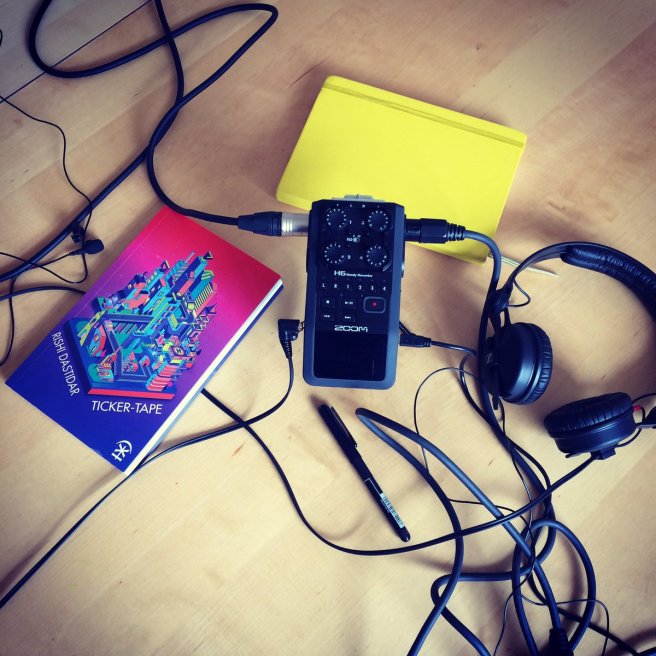
Episode 103 is an interview with Rishi Dastidar is now online. David Turner chats to Rishi about his latest collection Ticker-tape (Nine Arches Press) and the editing he does for The Rialto and poetry blog And Other Poems.

Download it for free here on Soundcloud or here on iTunes. Download a transcript of the conversation here or see below for the transcript (minus poems)…

DEEFJ5oXkAIktHp


Introduction:


DT:      Hello. Welcome to Lunar Poetry Podcasts. I’m David Turner. How are you lot? Can you hear that? That’s right. There’s nothing there but nature. I’ve moved to Wiltshire. Lunar Poetry Podcasts is now based in the South West of England, where it’s very quiet and there are ducklings at the end of the garden, wood pigeons and swifts, something squeaking in the tree.


Today’s episode is a bit of a break from the norm, in that the entire episode is dedicated to one guest. This is because our Arts Council funding runs out in August and after that, we’ll be returning to one episode a month and dedicating more time to individual guests. So I thought I’d get you used to the idea.


Today, I’m joined by poet and editor, Rishi Dastidar. We talk about his collection Ticker Tape, out through Nine Arches Press and the editing he’s done for the Rialto and Josephine Corcoran’s blog And Other Poems. After this episode, we’ve got two more Arts Council-funded episodes to come, after which we’ll be uploading single interviews on the first Friday of each month.


I’d love to know what you think of the series so far, so if you go over to www.lunarpoetrypodcasts.com, you can fill out a feedback form in the audience feedback section of the website. Over there, you can also download a transcript of this conversation. As always, you can subscribe to us via SoundCloud, iTunes and Stitcher, or wherever else you access your podcasts. You can follow us at Lunar Poetry Podcasts on Facebook, Instagram and @Silent_Tongue on Twitter.


Do remember, independent podcasts in general, not to mention ones about bleeding poetry, have no marketing budget and rely completely on word-of-mouth recommendations. So if you like what we do, please tell folk, either through social media or in person. Arts programmers and organisations need this, what with the Government and that. Thank you. Smiley face.


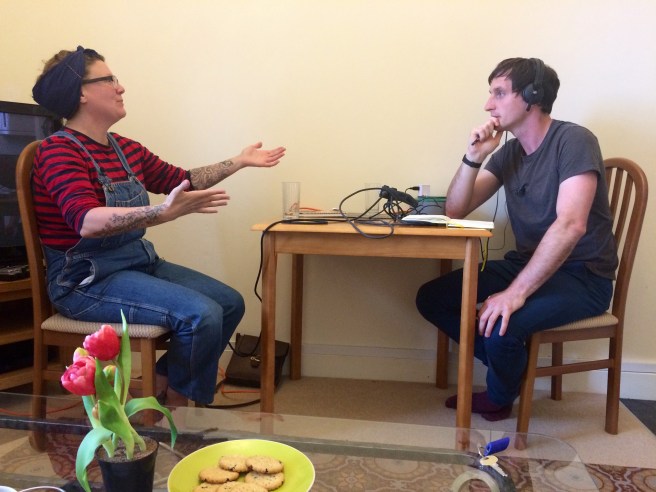
Onto the conversation. I recorded this in my flat in Kennington, South London, which isn’t as quiet and idyllic as here in Wiltshire. For a start, the flat is under the Heathrow fly path and the P5 bus runs regularly outside, but Rishi admirably holds his own among the vehicles, creaking chairs and neighbours’ kids. I won’t keep you any longer. Here’s Rishi. And me for a bit. But mainly Rishi. Enjoy.


Conversation:


RD:      I’m Rishi Dastidar. This is a poem from Ticker Tape. It’s called;

Poem can be found here 

DT:      Thank you very much, Rishi. Thanks for joining me. ‘Him with the teeth’, I really like that one. Could we start by talking about the collection, Ticker Tape, and how it came about?


RD:      So this is developing its own creation myth and story now, as well. So I think we have to go back to the spring/summer of 2015 or so. I sent some poems to Jane Commane at Nine Arches for Under The Radar, her magazine, and she’d taken a couple of those and in her note, she said: ‘Whenever you’re ready, I’d like to offer you some mentoring for a couple of hours, where we can talk about whatever you want.’ Now me being me, I rather exaggeratedly interpreted that as ‘ah, I wonder if…’


And so, towards the back end of 2015, I pulled together about 60-odd poems, just sent them to her, and in my notes said: ‘I hope this is OK for mentoring. I think I’ve got enough here for a book, but it would be great to get your view on that.’ Didn’t hear from her for about three months or so and then spring last year, 2016, I get this note back saying: ‘The offer of mentoring is still there, but I’d really like the book as well’, which I was not expecting at all, so I was completely bowled over.


It took me all of about five minutes to say yes, basically, which in itself is a great tale. I only found out a few months ago that when Jane said: ‘Send me some poems’, she was actually expecting about 15, rather than 60, so I rather bumptiously sent four times more than I should have done. Now I don’t know whether there’s a lesson in there about best foot forward or whether I’ve a classic tale there of a bloke over-interpreting the instruction.


DT:      There’s an important discussion to be had there for people who haven’t had contact with publishers or magazines much. How much of your work do you send to someone invited or unsolicited? Only a couple of publishers are clear enough on their website about what they expect. Before we talk about that, maybe we can talk about what the timescale was. When a book comes out, it can sometimes feel like you’ve done that in a couple of months and everyone publishing seems like a genius.


RD:      And it’s not at all. Just flicking through, the earliest poem in here is from about 2011, 2012. Matchstick Empire is probably the earliest that’s in there and it wasn’t complete as a manuscript to send to Jane until These Things Boys Do, which arrived pretty much at the end of October, actually closer to December 2015. It’s four years of accumulation.


DT:      Wayne Holloway Smith said in an interview that Alarum was a collection of five to six years. It seems, four to six, perhaps seven years, is more of a realistic time line.


RD:      That sounds about right. I’d characterise it as three phases. You’ve got the phase where you’re generating and writing. There’s drafting and redrafting within that. There comes a point where that phase finishes because you’ve got a sense that OK, I’ve got enough now. I’ve got enough that coheres, is coherent, and I’m starting to get the outline of the book. Then there is this sort of middle phase, where you are putting the book into some sort of shape.


For me, that phase was relatively quick in terms of moving from These Things Boys Do being finished, to actually going: ‘OK, that was the thing I needed, what does at least the initial order of the thing look like?’ And that was a couple of months. And then the process from Jane accepting it to it coming to a finished form is another year or so. So clearly, that middle bit feels very, very fast and that sort of feels like it’s the bulk of the work for you as a writer, but actually, the longer year, once the manuscript’s been accepted, is actually its own job of work in itself, but it certainly doesn’t feel to me an onerous job of work, because I wasn’t doing it on my own, I was doing it with wise counsel and input from Jane, with a sense, a definite goal of what we were trying to achieve.


DT:      How much effort was put into trying to find a coherent theme that runs through the collection? Presumably that comes in the last year, is that right?


RD:      Potentially. I’ve been shying away from saying there is a big theme in there. I know there’s been a bit of a vogue towards it, to almost say ‘yeah, this collection is…’ I find it interesting, because you can hear almost in the way people talk about it, that’s moving the collection to something that’s almost novel-like, because suddenly you can say 60, 70-odd pieces of work cohere to this idea and that’s fine, absolutely, but lots of collections don’t do that and there’s no need that they should.


A collection can be just a collection of the best poems that poet has written at that particular moment and they do not have to be presented with any particular theme or overarching idea. What the writer’s concerns are actually then come out through that. Certainly when pulling it together, I had no grander idea than what is my best work. Now, within that, it’s clear that certain subjects, certain topics, certain ways of addressing the world keep coming back again and again and again. There’s no way that I would claim this is one big vision of a particular thing.


DT:      Viewing editing as curation?


RD:      Yes.


DT:      I suppose that’s where this danger comes from, there must be a theme in a book. Anyone who has read the collection will see themes, but they’re pretty much themes within your artistic practice, aren’t they? I suppose that’s where my question came from. Did you just allow the work to fit together because it’s all written by one person?


RD:      I went into it knowing that a large chunk of the poems are, in some loose or tight sense, quote unquote ‘romantic’, going back to that slightly older definition of not just love and lust, but awe and wonder at the world as well. I knew that was going to be a strong strand and my initial thinking was OK, there’s going to be some sense of traditional boy-girl arc in there. That’s almost inevitable and inescapable, so that’s going to be a large chunk of the work, but then, knowing there was going to be such a chunky political strand in there as well, which I definitely wanted, because I wanted that to be a marker, to say: ‘Look, this is part of what I write about and it’s not going to be a part that can be ignored.’


So I wanted that to be a statement. So immediately there, you’re balancing two things which are pretty hard to cohere. Then when you’ve got Ticker Tape itself as the title poem as well, which sits somewhere between that romanticism and that political aspect, but also is a very urban poem. So then suddenly you’ve got those three things there. I could have spent time trying to develop an overarching way of tying those much more closely together, but actually…


DT:      I suppose  the longing in all of the poems is, I was going to say unifying theme, but I don’t mean that.


RD:      Its commonalities, its resonances, its themes. What really unlocked the book during the editing process is when Jane started to break it apart and put it back together and say: ‘Its not an arc, it’s a series of loops.’


DT:      Ah, that’s a nice way of putting it.


RD:      And when she said that, that’s when it suddenly all cohered, because suddenly that gives you permission to not worry about saying ‘we’ve got to get from A to B’, it’s fine to go from A and then back to A and for these things to stand alone and then to move into another cycle. So in a certain sense, I often think of the book as being three movements. You’ve got this opening movement before Ticker Tape, which is as traditional as I get in terms of quote unquote ‘love poetry’, then you have this monolith in the middle and then you’ve got this more political stuff after that, the state of the nation stuff.


Then, almost as a coda, the sort of quiet plangency of the front comes back again. I wanted to round it off on that one. I definitely knew where I wanted to start and where I wanted to end. I’d always had Summer of Camus’ Youth as the opening and I’d always had Theseus’ Ship as the end because I definitely wanted those moments of quietude. I knew I wanted the swell of the book almost to be, from something quiet, to get as loud as it does and then dip away again. I’d ensured that I’d given myself those fixed points, so then it was a case of making sure everything else fitted in.


DT:      This idea of looping, rather than a longer arc, do you feel you’d have reached that point without Jane’s mentoring input?


RD:      The book Ticker Tape is a classic example of how editorial care, support, attention, intervention makes something 5, 10, 20 times better. Every writer needs an editor and it doesn’t matter what art you’re writing, there’s no writer that cannot be made better with some form of intervention. The trick of it, as an editor, is knowing what form of intervention that is and how to deliver it in such a way that it works and the relationship is productive and mutually beneficial.


That’s hard because every writer is different, every editor is different, so if you’re an editor with multiple poets, multiple writers, how do you develop enough flexibility to work in the way that’s maximally optimal for that particular writer? Jane might disagree, but I think I’m relatively easy to edit in the sense that because I have been an editor as well, I know what, relatively speaking, the task is. I know it’s not an attempt to change my aesthetics or try and get me to write in a different way or do any of these sorts of things which are common mistakes when people start.


I understand that what we’re attempting here is a shared project in trying to make this thing better and so, when you start on that basis of good faith, it makes the process easier. Often, people approach it as ‘this thing is done, all you need to do is proof-read it and typeset it’. That for me, it just spoils, not spoils, it’s a missed opportunity. There is always going to be someone out there who can make the thing better, so why wouldn’t you take advantage of that? I almost view it like you find a co-conspirator, someone whose interest is to make the book as good as it can be.


DT:      Are there any other examples in terms of having an editor you felt you could trust? Also, because there was first an offer of mentorship, do you think it made the editing process any different?


RD:      Perhaps. Perhaps. I imagine that if I’d gone with a different place or gone with a different house, having a colder relationship might have made that a bit trickier, so already having this pre-existing editorial relationship through Under The Radar, that sort of helps and there’s that familiarity with your work. I knew at some level it would be tricky to find a simpatico editor just because the work is, to put it politely, it’s at one degree removed from the mainstream currents of most British poetry and I was going to resist any attempts to try and pare my style down or shave the excess off to make me sound more traditional or like current voices.


That’s not what I’m here to do, that’s not what I’m here to write. So that fundamental need was going to be someone who got the idea of what I’m trying to do in terms of maximalising what’s going on in the poem. I was trying to cram too much into them, trying to fill them to bursting, even before we get onto the whole making up words and the over-italicisation and all the rest of it. So there needed to be a fundamental grasping of that, which Jane gets. Jane very much licences my exuberance and a lot of my enthusiasm.


What she’s very good at is knowing when I’m going too far and when it’s starting to move to the stage when it’s actually being tiresome and being larded on, but also knowing that for that effect to have its maximum impact, the underlying structures, the underlying shapes, need to be solidly in place. I can imagine there is a version of this book where it is tremendously tedious and wearing because it’s looser, much more in free verse, I haven’t worked as hard in terms of stanzas and line breaks and actually bringing shape to it.


I’m very, very aware that part of the reason I can get away with writing the way I do is precisely because there is some formal lyric discipline lurking in the background somewhere. Again, part of the editorial process was knowing where to accentuate that and where to put that control in.


DT:      We’re definitely going to get on to talking about editing a bit further, later on. I just can’t take my eyes off the cover. I’m painfully aware that people can’t see what we’re talking about, so please Google Ticker Tape by Rishi. We might, if possible, put an image of the cover in the episode artwork. We chatted briefly about this, at the Peckham Pelican, when you did the Nine Arches showcase through Vanguard Readings recently, about how it’s really refreshing to see a handful of publishers at least are really putting a lot of effort into book design.


I really hate it when people tut at me and say: ‘You shouldn’t judge a book by its cover.’ That is bullshit. I know the visual look of the cover is important to you, it perhaps wasn’t a press decision, it was something that was going to occur anyway.


RD:      Part of that back story comes from the fact my day job is in marketing, design and branding, so I live in this world a lot. The actual impetus came from my colleague Sophie at work, who I sit next to and is the creative director at the agency. She was playing a lot of Monument Valley and at the time we were thinking about the cover, just really entranced by the visuals. She said: ‘You know, your book cover should feel something like this, be something like this.’


I literally took that as the brief to my sister, who’s an illustrator and animator, and said: ‘Do you want to have a go at bringing this to life?’ She had an early draft of the book as well. That’s what came back. I knew pretty much immediately it was right, because between Sophie and Ria, they captured the essential bit of the book. In my mind, Ticker Tape speaks to some form of a Utopia, absolutely it does, and the fact it was this multi-hued, bright, glossy, glowing thing was just absolutely right, because at some fundamental level, it really brought to life not just my voice, but also the way that I wanted the voice to be seen.


DT:      Just a very basic reaction, it’s got that sort of Sin City element, this idea that you’re just putting blocks down and building others. It’s also got a touch of the [MC] Escher’s about it, hasn’t it? It doesn’t look like you could quite walk round it.


RD:      So you’ve got that loop in a sense again, which we come back to. You’ve got that sense of techno-futurist dynamism in there, which through jargon and through subject matter, the poems get to as well. Just actually the brightness as well. I think of a lot of the book as quite joyful, much as it’s undercut by longing, there is a lot of joy in there as well, so I wanted that sense of upbeat and optimism there. That’s in part why Ticker Tape is the title poem and the central motif, because those things are intentional, aren’t they?


The sheer fun and frivolity of having a massive parade to celebrate some amazing achievement and success, but you also know there is the comedown after that, the emptiness after such a thing. There is the clean-up, there’s the stuff that’s left behind. I wanted those two things in tension there, but I wanted to flag the upbeat and the optimism as much, if not more than, the downbeat stuff because I think the downbeat is the traditional way a poet would go.


Again, this comes to thinking about difference, thinking about my position in relation to how and where everyone else is writing. It’s just instinctive. If everyone is slightly more downbeat and saying: ‘Look how grim the world is’, I want to go: ‘Well, it’s not all bad.’ Just as a point of difference.


DT:      I think it works really well, the colour and there is a sense of optimism on the front cover and the back cover. In between, you can get a little bit darker, can’t you?


RD:      Absolutely. There is, sitting on my hard drive somewhere, an earlier version of the cover where it’s a black background and the city is sitting on that darker thing. It looks super cool, but it just looks that little bit too cool and it doesn’t quite give you… You know, I am not cool, I’m not a cool poet, and there’s something lovely about the gaucheness that comes through this pop of colour here and the neon as well, that again speaks to the book and speaks to me.


DT:      I think we’ll take a second reading from the beautiful book.


RD:      As I talked about it, I don’t think I’ve read it properly before, so let me read These Things Boys Do. Let me tell you that Katherine Angel, the writer and critic, she posted a seminar on desire at Somerset House a couple of years ago and I went along to that. Katherine is such an interesting thinker and interesting writer and it was a really interesting conversation that people were having, so I was scribbling lots of notes and I knew there was a poem in there.


As it turned out, that poem had to be in the book, but it just wasn’t coming, it was taking forever to arrive. Then it finally did and I think it’s one of the longest poems to emerge from initial conception and knowing it’s there to arriving. That was 11 months or so. Let’s hope it was worth it. It’s called;

Poem can be found here 

DT:      Thank you very much. That’s enough of the book. We should talk about the editing that you do.


RD:      Yes. So the two big ones are the Rialto, where I was, along with Holly Hopkins, the second cohort on the editorial development programme, and that was a couple of years ago now, so 2015, 2014 maybe? There have been a couple of cohorts since then. That involved working with Mike Mackmin to put together one edition of the magazine and then Holly and I were let loose on another edition of the magazine, where we effectively put together a quarter of it.


The other place is And Other Poems, where I help Josephine Corcoran out with various bits and pieces. That’s a different type of editing that’s going on in part, because different medium, print versus blog, different editorial ethos and approach and what Jo is trying to do with And Other Poems as well. So they’re both good tests and stretches of editorial skill, editorial judgement as it may be.


DT:      I just wanted to say, if people don’t know And Other Poems, they should get over there http://www.andotherpoems.com


RD:      The philosophy there is very straightforward and simple. Jo publishes the best of what’s sent to her and what she likes and it doesn’t have to be new or unpublished or whatever, it’s just a chance for people to share what they feel is good, interesting, their best work or whatever. I think the way it’s become such a clearing house, and I don’t mean that negatively at all, but a really good chance for people to catch up with poems they might have missed first time around in other places, there’s a lovely sense that poets use it as ‘this is a thing I was really proud of, can we see it again in circulation?’


I came aboard last year, to help Jo when she did an open call for submissions and she had loads, so I helped her edit and select and choose bits and publish. Then this year what I’ve been doing is curating a showcase of Complete Works 3, poets as well, so I’ve asked them to select some of their favourites, then I’ve been publishing them every Friday for the last couple of weeks, so we’re just coming to the end of that in two, three weeks or so.


So clearly there are different things that happen when sifting through an open call. The Complete Works 3 stuff is not a commission per se, but that call is very much: ‘I’d like your three to five best poems, please, or the ones you think are best, or whatever you’re writing now and I will choose my favourites out of those.’ It’s a different task in the sense that you know the cohorts, the guys are working at such a high level, you don’t have to worry about will they meet sufficient quality. Whatever they send is going to be good enough to publish.


The considerations then come in around: Are these the favourite aspects of their voice? Are those particular aspects of their poetics that I like? Is it roundly representative of their poetics for an audience that might not have heard them? How do I balance the range of subjects and concerns, because I don’t want eight, nine weeks where thematically, the poems are similar? Chances are, amongst the cohort, that’s not going to be the case, but I need to at least have that at the back of my mind.


Just very straightforwardly as well, a balance of rhythm and pacing over the couple of weeks, in terms of thinking, if I ‘ve got two fairly traditional-looking poems one week, am I going to push you the next week with something that’s a big, Ashbury- like block of text? Things like that. There are those sorts of considerations as well.


DT:      How far do you plan in advance with that?


RD:      So I asked the guys in March, April, then we started publishing at the beginning of May.


DT:      In terms of the run when the poems go out, how far ahead are you looking for your schedule of publishing? Do you allow yourself any flexibility to switch things around?


RD:      A little, but generally, I’m scheduling and editing and prepping for posting about, two or three weeks in advance. So if I do suddenly have a fit of ‘I want to change things around’, I’ve got enough time to do so. But actually, the guys have been so good at responding in terms of when they got back and stuff that it’s all come together relatively straightforwardly. I did, and it shows you how far the online world is not actually that different from the offline world, I did actually for the 10-12 I’ve chosen, I did actually put them out on the floor and see how they were feeling.


DT:      The classic editorial shot of walking through the poems.


RD:      Exactly and even knowing it’s going out online, it’s not going to exist as people’s pages. I still find that’s a really good way of working through the rhythm of something, even though I know people are not going to consume it whole, people are going to consume it in weekly episodes.


DT:      What I really like about the blog format, especially And Other Poems, is the archive is there. You can access it as a block if you wish to. That’s one of the major differences in putting out publications, that people may only ever see that one magazine and it has to work coherently through that. Obviously, there will always be a call-back to the history of the publication, but they all stand alone.


RD:      Part of this betrays how I was trained. My first proper jobs were in journalism. I was a sub-editor. Most of my training was done on print, so I used to know my way round Quark Xpress with a dangerous facility, so I could lay out pages. One of the things I was taught when being trained was when you’re looking at a page spread, you’re always having to be aware that you’re trying to grab the attention of people who aren’t necessarily that interested in reading it. So what you have to do to the page to allow people ways in so they want to, so obviously headline, obviously picture captions, pull quotes, straplines, whatever it might be.


That training has never left me. Whether it’s print or online, part of what you’re thinking always has to be, I have to assume that people are not going to be interested. How do I make sure that I get at least enough, a sliver of your attention, to make sure that you stop and at least peruse this? This is why, when teaching in workshops, I bang on so much about titles and I bang on so much about first lines, especially in an online context, when you can have this disembodied poem floating about, or that’s been tweeted or Facebooked or whatever, there isn’t necessarily the context of where it comes from, you’ve chosen to engage with it so you might do it. How are you going to make sure that person stops and goes: ‘der der der der der’?


DT:      I’m definitely going to misquote this person, because I think it was Wayne Holloway-Smith quoting Luke Kennard and I’m not sure Wayne could fully remember the quote anyway, but it’s in the episode where Lizzy interviews Wayne, but Luke said something along the lines of one of the biggest problems with modern poetry in the UK at the moment is it assumes an interest upon the reader into their life or their work. It’s just that idea of how do you communicate and engage with people?


RD:      I feel a rant gathering. So it sounds paradoxical, but I do try and retain the perspective that most of the people who I am trying to reach and who might be readers are not poets. I know concretely, whatever it means data-wise, that’s not the case. We know that most poetry publications, whether online or offline in the UK, are consumed basically by fellow practitioners. My fear, my worry, is that not warps our editorial judgements, but to a degree sort of skews the way we think because it’s a different beast to serve a fellow working practitioner than it is to serve the interested general reader.


Now, there is absolutely a discussion to be had about the fact that British poetry suffers from this lack of the interested general reader who doesn’t want to be a poet, because it’s not necessarily healthy for an entire art form to only be consumed by people who are producing that art form. I love the notion and the fact, there was some American piece I read the other day, it was one of those ‘poetry doesn’t make any money, why is it still thriving?’


The argument that the poet put forward was: ‘It’s thriving because people read, people get inspired, people want to continue and participate in the conversation.’ That’s absolutely right. I’d add the rider to that, that the conversation is stronger if you have interested lay people who don’t have an axe to grind in terms of being poets themselves, coming to the art form and enjoying it and participating in that world as well. That being said, I try and retain at least that idea that amongst the potential readers out there are people who are interested in poetry, consume poetry, but don’t necessarily write it themselves.


I think that slight wrinkle gives me a slightly different perspective when it comes to some of my editorial choices. Not least one of those is being, we can call it tougher, we can call it being shameless, being more marketing-driven, but just actually banging my fist on the table a couple of times and saying: ‘Who the fuck do you think is going to read this? Who is going to read another poem called Rain?’ Christ almighty. At least trying to give people and leave people with the impression that it’s OK to sell your work through the title, through the first line, it is not a diminution or corruption of your poetics or your art to try and at least grab someone’s attention. I’m sorry if this sounds heretical.


DT:      It really rings true with the way I built the foundation for the podcast. I was safe in the knowledge a lot of the poets I knew would listen, there were the guaranteed audience, still relatively small, but I wanted other people to come and listen, friends and family who had no interest in poetry until you present something of interest and open their eyes. Not open their eyes, that’s patronising, but…


RD:      I think you have to operate on the basis that most interested readers are intelligent enough that with a degree of contextualisation, framing it correctly, they will get what you are doing. Again, that comes from my training. I trained at the Financial Times. You know that most people don’t engage with financial news unprompted. There is a work reason or whatever.


So you know you have to, without question, explain some pretty complicated stuff simply, but once you do, they will go on and chase those hares themselves, to throw in another metaphor. Again, that’s part of what underlies my thinking. You frame things properly, you set things up properly, that should be enough to bring people through. This is not saying it needs to dumb down or cheapen, it’s just saying you need to have enough ways in.


DT:      Really simple things like not assuming knowledge on the listener. Don’t assume they know what a form is, or what the context of a certain poem is like.


RD:      Another thing I was taught, someone is going to read something for the first time always and will not know what you mean. So however much you know it, you owe it to them, that potential first-time reader, to make sure you’ve done enough to let them in.


DT:      That’s the perfect place to stop. It’s a really good, strong message. A lot of programmers and organisers need to bear that in mind when they’re claiming to the Arts Council that they’re engaging new audiences. Thank you very much for joining us, Rishi. It’s been great fun chatting. We’re going to finish with a poem.


RD:      OK. I always end with this. I don’t think I’ve actually tried it inside, because when I do this on stage, I bellow it. Let’s see how it sounds when I semi-bellow it. I always introduce it by saying: ‘Everyone in the creative writing world has always used this word to describe this object and if you do one thing, never use this word to describe this object again.’ This is called;

Poem can be found here

DT:      Thank you very much. That was great. Links to where people can find you and books and stuff, I will put in the episode description, I think it’s the easiest way. But just to repeat, Rishi’s collection we’ve been hearing today, Ticker Tape, is out from Nine Arches Press, who have got some really great stuff coming out this year, not least Stairs and Whispers, which is an anthology we’ve been talking about a lot and will come up again in two episodes’ time. Thank you, Rishi,


RD:      Thank you very much.


End of transcript.


Ep.99 – Come Rhyme With Me; Anthony Anaxagorou

15:05:2017.jpg

Episode 99 is now up online here.

Part One: David Turner talks to Dean Atta and Deanna Rodger about their regular poetry night, Come Rhyme With Me which takes place at Ovalhouse Theatre in south London.
www.facebook.com/ComeRhymeWithUs/
twitter.com/comerhymewithus
sites.google.com/site/deanatta/about
deannarodger.co.uk/

Part Two (30:58): David Turner talks to Anthony Anaxagorou about his poetry organisation, Out-Spoken. The pair discuss live events, publishing and writing masterclasses under the Out-Spoken umbrella.
twitter.com/OutSpokenLDN
www.outspokenldn.com/
anthonyanaxagorou.com/

You can download a full transcript here or see below:


Introduction:


DWT:   Hello, this is episode 99 of Lunar Poetry Podcasts, I’m David Turner. A special hello to anyone tuning in as a result of meeting us at the Free Verse, Poetry Magazine Fair in London on the 13th of May. Thanks for joining us.


It’s been a little while coming but I’ve finally made a website for the series. The main purpose of the site is to house all of our episode transcripts of which we have about forty up online. A big thank you to Arts Council England for making that possible. I’m also going to endeavour to keep a blog running on that site so if you want to follow that or download episode transcripts you can go to www.lunarpoetrypodcasts.com


As well as that web-site you can find us @Silent_Tongue on Twitter and Lunar Poetry Podcasts on Facebook, Soundcloud, iTunes and Stitcher or wherever you access your podcasts.


Today’s episode is in two parts and in both interviews our guests talk about putting on poetry and spoken word events, how they view the organisation of these events as acts of curation and the role that open-mic does or doesn’t play in these nights.


First up is Dean Atta and Deanna Rodger talking to me about their regular night Come Rhyme With Me which takes place at Ovalhouse Theatre in Kennington, south London. I refer to the theatre at times as the Oval Playhouse because I’d been editing our previous episode in which there’s a lot of talk of the West Yorkshire Playhouse and it would seem I can only hold one place name in my head at any one time.


If you enjoy this episode then please tell your friends it helps a lot and is much more effective than advertising. Your friends are going to trust your opinion much more than any of my Twitter or Facebook updates.


As I mentioned before, go over to www.lunarpoetrypodcasts.com to download a transcript of this episode.


Coming up in the second half is Anthony Anaxagorou but first here are Dean and Deanna.


Part One (02:04):


Host: David Turner – DWT


Guests: Dean Atta – DAt & Deanna Rodger – DR


DAt:     Hello, I’m Dean Atta. This poem is called The Black Flamingo and it’s a three-part poem from my forthcoming collection;


Poem can be found here


DWT:   Thanks very much Dean.


DAt:     Thank you.


DWT:   Hello both Dean and Deanna.


DR:      Hello.


DWT:   How are you both doing? Thanks for joining us.


DR:      Thanks for having us.


DWT:   Not at all, I’ve been really looking forward to this.


DAt:     Me too, I’m a fan.


DWT:   Oh, that’s brilliant. It’s really weird when I actually get to meet people in real life that have listened… That I wasn’t necessarily friends with before the whole thing started. I just assumed it was my dad and a couple of friends [listening], multiple times.


DAt:     It’s great to put a face to the voice I’ve become so accustomed to.


DWT:   It’s really nice to be meeting at my local theatre which is in south London which is always a pleasure, to not have to cross the river to meet people. The reason for that is because you both have a regular event here, so maybe Deanna you could just tell us a bit about the event.


DR:      Dean and I run an event called, Come Rhyme With Me and we’ve been running this for about five years…


DAt:     Since 2010.


DR:      Seven years! We’ve got a residency here [at Ovalhouse Theatre] and the night runs every… [DAt: Season] Yeah, every season.


DAt:     We’re in a theatre now so it’s seasonal.


DR:      It’s the first Saturday of every ‘season-month’. [LAUGHTER] This is really great promo, isn’t it? It’s a really fun, relaxed event which… I love it, I hope Dean does.


DAt:     I love it too!


DR:      We’ve combined food and poetry in order to create an atmosphere which is quite communal and welcoming and, kind of, eradicates those boundaries pretty quickly… I mean, when you’ve got to stuff food in your mouth in front of strangers… Yeah, I mean it’s like a first date, isn’t it?


DWT:   Yeah, it’s interesting because I used to run a monthly poetry night with my partner Lizzy, in Lambeth, and we tried to find ways to break the formality of a poetry night. Even if it’s spoken word you still have that formality sitting down and if you’re in a theatre space people respect that boundary between stage [and audience]. It seems like a really simple, and now I’ve heard of it, obvious thing to do is to get people to eat. Because you can’t be formal necessarily and share [food] and break bread in that way.


DR:      Break bread, that’s it.


DAt:     Yeah, when you come in, you’re with other people around the table or on a sofa with other people… We have a couple of sofas at the front and we have tables and chairs and people just sit together, eat together, chat in the breaks. We make sure there are breaks so that people get to chat to each other. We try and be there after the event, as well, so it’s not like, “The poetry’s done, go home”. It’s more like, “The bar’s still open, we’re still here, let’s have a chat. Let’s hang out, talk to the poets, talk to each other”, that kind of vibe.


DR:      Because Dean and I know each other so well… We’ve known each other for ten years now… We’re really comfortable with each other on stage and being friends on stage and I think that translates to the audience in terms of just creating an atmosphere where you can just have fun.


DAt:     There’s lots of banter.


DWT:   But it’s poetry, it’s not supposed to be fun and comfortable. It’s supposed to be awkward and isolating. [LAUGHTER]


DR:      Sometimes I do go to events where it feels awkward and it’s not anything that… I’m sure for other people it doesn’t but for me, I’ve certainly sat in that audience and felt quite stiff and not relaxed and not laughed with my belly.


DAt:     We just smile a lot, we laugh a lot. We make jokes, even ones that aren’t funny but we laugh at each other’s jokes, even when they’re not funny.


DR:      What? I thought my jokes were funny!


[LAUGHTER]


DWT:   Deanna, I’ve heard you’re very funny!


DR:      I’ve heard I’m funny too!


[LAUGHTER]


DAt:     It’s really good fun and I think whether it’s someone in the ‘appetiser’ section, which is what we call our open-mic, or someone that we’ve booked to perform, I think we give everyone really nice introductions and make everyone feel welcome. We thank them for coming and for performing and just, kind of, make sure people know they’re welcome back and they can bring friends. Last month, one of my friends who had come the month before and had brought ten people this time. It was just so good to see [that] people love it so much they’re going to bring ten people.


DR:      Even coming for their birthday, which has been marvellous to see.


DWT:   Poetry birthday?


DAt:     People celebrate wedding anniversaries at our night, people have office parties, like bring their whole office with them to Come Rhyme With Me, so it’s good fun.


DWT:   What’s the structure of the night? You were just saying about the ‘appetiser’ section.


DAt:     Yes, we set it out like a menu. So, we have ‘appetisers’, that’s the open-mic section.


DR:      Six slots.


DAt:     Six slots of three minutes and then we have our ‘starter’, ‘main course’ and ‘desert’ and that is just a way of, kind of, giving a different flavour to each performance. And it gives us a way to think about who to book alongside each other, like, do they complement each other.


DR:      Like a meal.


DAt:     How will it flow? Like a meal, would you want to have that, then that, then that?


DWT:   So, you try to curate the evening as it were?


DAt:     Yeah. You know, it’s not just about who’s available, it’s about who’s going to go well together. It’s not just about who asked us to do the gig, it’s about who we feel would fit in that particular line-up. So, yes, it’s really fun to make that menu and be the ‘chefs.


DR:      Or the waiters.


DAt:     Or the waiters, we didn’t cook it up.


DR:      I think it gives a really nice flow to the event and there’s no hierarchy, if that makes sense? Sometimes you’re waiting for a headliner and actually… Even the appetisers has a real status to it and a role to play in, kind of, whetting people’s appetite and getting our minds in tune [for the event].


DWT:   I suppose using that analogy of a menu it does link the open-mic more to the features, doesn’t it? Because you can’t get away from the fact, if you’ve got open-mics and then the features… Those are two separate things at any event, aren’t they? Even if they happen in the same night. You are, sort of, getting one out of the way to move on to the next section and quite often open-mics are just used as a way to keep people in the door anyway, aren’t they?


DAt:     Well for us, I think it’s great to be able to see fresh performers, see people try out new stuff, you know, meet other people. Because some people will only come if there’s an open-mic because they do want to perform and I think that’s fine. That’s great and I like that we have that section but it’s a limited section of six performers and I think that’s good because enough variety comes out of that and it gets everyone excited.


But also, you know, there is a case for having feature acts because you can guarantee something about that, you know what you’re going to get there. We get wonderful surprises in the appetiser section but usually our features do what we asked, or not asked but what we would expect. [LAUGHTER] I make requests, I’m not going to pretend.


DR:      Do you make requests?


DAt:     I request certain poems sometimes from a feature.


DR:      Wow!


DAt:     Because if I’ve loved hearing it before and I’ll be like, “I think our audience will love that poem. Will you please do it?” You know, I sometimes feel funny when people make requests of me when they’re booking me, so I know it’s not ideal always. But sometimes I just think, I’d be so upset if they don’t do that poem, our audience would love that poem.


DR:      I also think that it’s like, you’re being booked based on your work and what people have seen. So, you do want it to be… If I’ve booked you because I’ve seen you do a set and thought, that’s going to work at the night and then you rock up and do a whole ‘nother thing.


DWT:   It’s like the cliché, isn’t it? Going to a concert and the groan that goes out when someone says, “And now for a new one” and everyone [collectively] goes, “No! We came for the album”.


DAt:     I went to see Erykah Badu live once and her new album had just come out and I hadn’t listened to it. She only did that album, pretty much, and I was so upset and it wasn’t until I went home got the album and listened to it for a long time that I started to appreciate those songs. But on first listen and done live, I wasn’t into it because I couldn’t sing along. I didn’t know it, I didn’t feel involved in it.


There’s something to be said about getting the chance to hear new stuff as well and I like when a poet will bring in, you know, a couple of new pieces into a set. So not just like, their ‘greatest hits’ every time. I think it is nice to have that opportunity for them to even open their notebook and share something fairly fresh.


DR:      Certainly. This is sometimes peril of not going to open-mics once you get to a certain place because then the stakes to try out new stuff become greater. We had a really fantastic performer, one of my favourites Disraeli, who dived in and just said, “I’m going to just do new stuff”. That was in December [2016], maybe, and it was fantastic and it was such a honour to see a great performer be so vulnerable with new stuff and to really bare open their soul without it being edited and crafted into the final polished piece. So, there’s pros and cons.


DWT:   I just wanted to ask about this idea of thinking about the night in terms of curation. Was that a reaction to anything else? How did that idea come about?


DAt:     Our first venue for this night was a restaurant and I think because… Naomi Waddis who is a poet, a photographer and a wonderful person, she knew of this venue that now is close. It was a restaurant and in the basement, they had a space for performance, with a stage and DJ booth and it was just really lovely. It was a Caribbean restaurant and Deanna and I are both part Jamaican and that factors into our tastebuds, I think.


So, the fact that we could have an event in a place with Caribbean food [DR: Spoke to us.] yeah, it spoke to us. I don’t know how [it came about] but, ‘Come Rhyme With Me’ and it all just fell into place, you know, and doing it like a menu. I mean, there have been times when other people have suggested, “Oh, if you made this some sort of competition this would be really good for TV or radio” but I think competition isn’t part of our event. It’s not a slam, it’s just a showcase of talent and an opportunity for open-mic, as well.


So, yeah being in a restaurant, Caribbean food and now we’ve moved to different venues we always keep the Caribbean food element of it. If the venue doesn’t have it we get it catered in because it’s just so important to the identity of the night and it makes us feel good. Some people, genuinely, they are as excited about the food as they are about the poetry.


DR:      So you get an eclectic audience.


DAt:     Yeah, definitely.


DWT:   You’ve got an event coming up on the 3rd of June, that’s your next event here, isn’t it? What’s the best way to check that out, is it through the Ovalhouse website?


DAt:     Yes, the Ovalhouse website or Come Rhyme With Me is on Facebook and Twitter.


DWT:   I’ll post all the links in the episode description so people can just click on those.


DAt:     Yeah, but it is advisable to book.


DWT:   Yes, it’s a busy event, isn’t it? And don’t be ridiculous, book the ticket with food, right?


DAt:     Yeah! Are you coming to the next one?


DWT:   I was so ill for the last one, I was really bad. Yes, I am coming to the next one. We should talk about yourselves as individuals now. Dean what are you up to now and in the future?


DAt:     I am doing quite a few things. So, I’m working at Tate Britain, I’ve got a residency there with a wonderful artist called Ben Connors and he’s illustrating my poetry on the walls making a mural in the Learning Gallery at Tate. We’re having something called an open studio and it’s for my new collection, The Black Flamingo. So, people will be able to come in, hear my new work, write with me and contribute poems to a zine that we’re producing.


As well as do art, talk to Ben about his process and we’re going to be having workshops for school kids and we’re also going to be having ‘pop-up’ events featuring Travis Alabanza at one of them and Keith Jarrett at another. The Black Flamingo zine will come out at the end of May and the deadline to contribute to it will be the 25th of May [2016], so if anyone wants to find that, find me online and find the call-out for that, or you can post that.


DWT:   Yeah, I’ll definitely do that.


DAt:     You can just email your contributions to theblackflamingozine@gmail.com and it’s anything, really, about identity. We’re specially asking queer people of colour to send stuff in but we’re going to look at everything from everyone because everyone has something to say and I would love to read it and hopefully put some of it in the zine. That will be given free to people at Tate and there will be a PDF of that online as well, so that’s something for people to be part of and that’s what I’m most excited about. But there’s other stuff coming up as well that’s kind of not quite begun. So, there’s a lot going on in Brighton for me and it will be announced soon.


DWT:   Is this the first time you’ve worked in an institution like the Tate?


DAt:     No, I’ve worked with plenty of institutions. I’ve done stuff with National Portrait Gallery, with Tate Modern and Britain before, with the British Museum before. Deanna and I were part of Keats’ House Poets which was… You know, Keats’ House is funded, well supported by the City of London Corporation. So, we’ve been involved with these establishments and it’s always very controversial amongst a lot of poets, in general. Don’t you think?


DR:      I think I just filter out stuff like that. [LAUGHTER] I mean what are you going to do?


DAt:     I see it as reparations. Like, you know, there’s a lot of these institutions that have benefitted from, you know, our ancestors and I feel like if I can get something back from that and my voice is still valued… You know, I don’t feel like I’ve ever felt ‘token’ or, you know, my words have been used out of context. So, the work i get to do is predominantly writing poems and they don’t edit my work and doing workshops with young people and they don’t edit my workshops. So, that’s, you know, a chance for me to put my voice into these institutions.


DWT:   What I was also wondering though is, it’s one thing feeling respected in those spaces because, you know, you’ve been invited or commissioned or whatever and it would be some pretty crass behaviour to not feel welcomed in that situation. But do you feel like, especially with this call-out for this zine. Do you feel like you were able to get the audience that you want in those spaces? Because it seems that those spaces still intimidate a lot of people, did you find that you’ve been able to bring in the people to work with you that you’d like to, for that?


DAt:     So far, yeah. I mean, audience foot-traffic, you know, people coming into the exhibition we don’t know yet, we’re still getting it all going. But in terms of collaborators, everyone I’ve asked to be involved has been like, “Yeah, great”. They have money so I can pay people to be involved so that’s been good. It’s obviously an interesting time at the Tate, they’ve got their Queer British Art exhibition and that’s had some mixed reviews about the diversity of that exhibition and whether it is representing Queerness at all. So, that’s going to be really interesting that my exhibition with Ben is along the same time as that, so it will have a conversation, I guess, with that work.


DWT:   So, Deanna what have you got coming up?


DR:      I think most excitingly I’ve got a collection coming out.


DAt:     Woo!


DWT:   Who is that with?


DR:      It’s with Eyewear and it’s really exciting. It’s currently called, The Mariahs and I’m trying to think of a little tagline to follow a colon, like, ‘Iconic Poems’ or something because it’s my greatest hits. I’ve been writing for ten years and never released a collection, so this is going to be all those ones that you ‘throw out’, that lots of people know and have heard thousands of times. So, it’s really exciting for me to release that in book form and also clear [the] way for new stuff to grow through it. So, I’m working on that at the moment.


DR:      We’ll be pulling together a tour over summer of some sort. At the same time [I’ll be] working closely with, I say my punk band but it’s our punk band in terms of it’s with three of my best friends called Sh!t S!ck. Some music videos have been released already, I was out of the country whilst they were being filmed so check them out, they’re absolutely awesome.


DWT:   Where can people find those?


DR:      If you type in, ‘Sh!t S!ck’, with the ‘i’s as exclamation marks.


DWT:   You’d have to be pretty careful googling ‘shit sick’.


[LAUGHTER]


DR:      Why? Can’t do it in schools obviously.


DWT:   A lot of stuff is going to come up.


DAt:     Grim.


[LAUGHTER]


DR:      Yeah, don’t click on ‘images’. I mean, I might click on ‘images’ now and there’s a YouTube channel and you can see stuff from the launch party which went really really well. We’re going to be doing stuff over summer, kind of, looking at how we can build on these characters that we are… But [mainly] performing and finishing up workshop programs that have been working on and stuff.


I’m going write a musical with the Young Vic [theatre], which is really exciting. So, I’m looking forward to that process and it’ll probably kick off in September but we’ve got some workshops this side of the year. [DWT: Busy!] Yeah, busy. It’s interesting because there’s so many ideas and semi-started ideas that I really want some time and space to sink into myself and rediscover myself as an artist. What my voice is and what I’m drawn to when I’m not being governed by paid work.


So, I’m seeing that at the moment and that’s why this collection, coming out, is really great because it feels like, “Okay there’s an object I can just, kind of, use that as a tool to swing myself into a new current of expression and be braver”. I think I really want to start thinking much further out of the box and pushing on ideas.


DWT:   Do you find it’s easy to maintain a balance between paid work, relevant work and being brave as an artist?


DR:      I feel that I have to stay up 24/7 in order to get that balance sometimes and I think that is a discipline. I think, for me personally, it’s been a journey of worth and understanding what my worth is and where value is and trying to place that as an internal thing rather than an external thing. So, rather than letting people dictate what I’m worth and where my time should be spent, taking back the reins maybe for the first time in my life. So, it’s still an ongoing battle because there’s so much pressure to be earning and be successful.


DWT:   It’s tiring fighting against those expectations, isn’t it?


DR:      Yeah, but it’s an exciting in challenge to have.


DAt:     I think, for me, it’s just reached a point where I just have to say no to lots of things even paid work because I feel like, I’ve got to go where my energy will take me, where I feel excited to go. I don’t want to drag myself into work because it’s paid, equally I don’t to miss out on things that are not paid but I’m really excited about. So, I kind of have a balance of, more having enough things that bring me joy.


You know, whether they’re paid or not paid. Whether that’s work or not work, you know, whether it’s people, whether it’s activities. Whatever it is, I just think I’ve got to be putting joy into my life because I don’t think anyone else will necessarily prioritise that for me. So, you’ve got to think about that. There is that pressure on us or expectation on, you know, “What have you got coming up? What are you doing next?” I think, I’ve been fortunate recently that I have something to say to that question.


[In the] last year or few months there was a time when I didn’t know and so many things were not sure and not confirmed or couldn’t be announced and when people asked that question I’ve just been like, “I don’t know, I’m just writing”. Or for four years I’ve just been saying I’m working on my new collection because I am and at the same time I’m not in a rush with it. As soon as you mention a new collection ever like, “When’s it coming out?”


I’ve had chance to explore it, the residency at Tate is exploring it further and the visual element of it being illustrated. However, I’m not going to rush to publish it just because people are expecting it and I think with everything I’m doing I’m not going to rush to write a one man show just because people want me to. I’m not going to rush to release this or that I’m going to just take my time and do things as I feel they should be done and I think that’s important as well.


DWT:   It took me a long time, with the podcast, to get past the fact that I didn’t have anything tangible to show. Especially with my background as a furniture maker. You know, all of my toil and endeavour resulted in tables or chairs on windows, there was always something to show for it. But with this digital medium… And the amount of thinking that goes into this and the amount of time you have to ruminate on stuff and just fighting that pressure to not produce physical objects.


DR:      For me, I almost have to, in order to celebrate something and it’s a practice that I think became clearer through this training that I did. There’s a project called, The Agency at the Battersea Arts Centre and the methodology comes from this guy called Marcus Faustini who’s based in Brazil. It talks a lot about getting the young people to create objects along the way so that their learning and their transformation is being consolidated even if it’s just kind of a tiny model that you can just put on a shelf so that there’s a visual reference.


So, within that I was working on a longer project which has taken me years and will probably take my whole life and there’s a lot of pressure, “When’s that going to come out?” and I feel like I’m failing because… And I’m not failing, I’m stewing, I’m marinating. But to, kind of, counteract that I’ve developed a new show with a performer called Gemma Rodgers called, Earth which is a complete left turn, right turn however you want to put it. That allowed me to consolidate learning from another process in that which I found really useful to create something just off the cuff and that was really fun. In order to take the pressure of feeling back I was able to create things, if that makes sense.


DAt:     I think I did the same with drag. So, I recently did a drag performance at the Royal Vauxhall Tavern. It was a ten-week course run by Michael Twait and it’s called The Art of Drag. We went every Monday and learnt different parts and elements to drag, did lip-syncing, looked at characters and costumes, comedy, everything and it was fantastic. I saw it advertised in January and I just signed up to it. Then, you know, as it was building up it got really exciting.


But then it got to be a pressured thing because I’d mentioned to people that I was doing it and then people wanted to come and I’d decided that I was going to do something around this Black Flamingo character that I am writing about. Then suddenly it was like, “Oh your drag show, that’s from your book” and it got attached to my work. Then it wasn’t just doing drag for fun, it suddenly became drag as part of your practice as an artist and I was like, “I just wanted to do something fun” but I turned it into work.


I do the same thing when I go away. I went to New York on holiday and ended up doing a school workshop and a performance at the Nuyorican because you don’t want to miss the opportunity to make it about work. Because you’re always thinking about poetry, you’re always thinking about creating and collaborating. When things start firing you don’t want to miss that spark of inspiration.


DR:      Yeah, there’s a lifestyle to it.


DWT:   I think that’s a really nice place to stop actually. With this idea that if it all feels too much, getting yourself out of your practice and getting into something else, finding that break and working together. So, everyone can check out Come Rhyme With Me at Ovalhouse Theatre in Kennington and I’ll post all the other links to the stuff we’ve been talking about in the episode description. We’ll finish with a reading from a Deanna.


DR:      This is going to be in The Mariahs and it’s called London Landlords and it was originally written as a commission for the Guardian and annoyingly I’m still in this position. This poem is maybe three or four years old but I’m still there.


[LAUGHTER]


[The author has not given permission for this poem to be used in the transcript.]


[30:48]


DWT:   Thank you very much. Thank you, Dean, thank you Deanna. Thank you for joining us. That was good fun.


DR:      Yay, woo!


Part Two (28:58):


Host: David Turner – DWT


Guest: Anthony Anaxagorou – AA


DWT:   Up next is poet, podcaster and founder of Out-Spoken, Anthony Anaxagorou. We chat about putting on spoken word events, organising writing masterclasses and his motivations for deciding to move towards publishing. This interview was recorded in February and at the time I wasn’t sure when I’d be publishing it so we didn’t mention any dates regarding events.


The next Out-Spoken Live event will take place May 31st at Union Chapel in north London featuring Inua Ellams, Amy León and Simon Armitage. Go to http://www.outspokenldn.com to book tickets for that and for information regarding upcoming writing masterclasses. Here’s Anthony.


DWT:   Hi Anthony, thanks for joining us today. How are you doing today?


AA:      Not too bad.


DWT:   Good good. Because we’re not doing any readings today we’ll start off with a brief introduction.


AA:      So, I’m a writer of poetry, fiction and prose. I do a lot of teaching in schools and universities around poetry and creative writing. I run Out-Spoken which is a night that I founded in 2012 that’s subsequently gone on to have a, kind of, master class element to it as well as a publishing house, Out-Spoken Press that we launched properly last year. Between all the other things I, kind of, sometimes work in different disciplines as well, using poetry and music, poetry and theatre and film.


DWT:   We briefly discussed, ‘off-air’, what we might talk about and we’re not going to focus too much on your work or your writing, personally, we’re going to talk about a few of the things. Just as an opening question, how long have you been writing before you thought, actually I’d quite like to run something on my own?


AA:      I think in 2009 is when I said I want to try and somehow establish myself as a professional poet and I set up Out-Spoken in 2012. I think the inspiration behind it was that I was, obviously… You do a lot of gigs and I was doing a lot of shows in different parts of the UK and everywhere had an open-mic element. As a lot of poets know, when you’re featuring sometimes it can be quite a taxing process to sit amongst the open-micers.


Not because people aren’t any good but because they’re still learning and a lot of them are inexperienced and the writing is quite rudimentary. So, yeah, I just figured maybe start a night that didn’t have that and just have, kind of, like a premiere night that had three feature acts, complemented with two musicians to break up the density of poetry. That was the initial idea and from there I just, kind of, worked the format out.


Obviously, you had Tongue Fu, they didn’t have open-mic but they had a band, so they had their own thing that they were doing. I’m sure there’s been other nights that have done a similar thing but people obviously rely on open-mics to bring the punters in so I just figured, let’s just rely on the weight of the poets.


DWT:               It can be a tricky thing to explain to people that you want to cut out the element of open-mic and it doesn’t necessarily mean that’s how you want every night to run. You’re just trying to offer a bit of variety, aren’t you?


AA:      Absolutely yeah. I figure that you’re not really doing a disservice or harm to anyone or anything because there’s so many open-mic nights. So, I figured, just have one that doesn’t have open-mic and there are some people, you know, members of the public, poetry lovers, readers, listeners who don’t want to listen to open-micers. They just want to hear professional poets read their work and perform their work, so I figure just offer that.


DWT:   Today is the 28th of February. [LAUGHTER] The reason I’m laughing is because I never look at my calendar and I never know what day it is and I miss a lot of nights. Your last one, I saw on Twitter, a tweet about and I was like, “Yeah, I’m going to that one” and then I realised it was pictures of the event that happened the night before. So, again, I’ve missed it but I’m definitely going next month. Maybe explain a bit… Just tell us who was on that night and how the night ran.


AA:      So, the format’s always the same, we invite three poets to read for 15 minutes and then two musicians with a break in between and it starts round about 7:30. We also have what we call like a floor spot or a sacrificial poet who is someone that we’ve either seen, an emerging open-micer usually, that we offer five minutes to right at the beginning as a as a way of showcasing what they’re doing and offering them a bit of a platform.


So, yeah, we had a young guy called Jamal who came down and did five minutes and then we had Selena Nwulu, the last London poet laureate Peter the Temp, Peter Bearder and then we had a guy call Nia. He’s a young singer-songwriter and I think someone saw him at Sofar Sounds, he did a gig there and he was recommended to us and we thought, “Yeah, he’d work”. Then we had a break and then John Hegley was the the main feature act and then Eliza Shaddad and her band took us out with folk-alternative-indie rock, kind of, vibe.


DWT:   Yeah, so you do have that sort of intermediate spot where you’ve got five minutes that’s given up to someone…


AA:      We introduced that later on simply because I, kind of… Again, to have a more of an exclusive feel to it, like you’re being invited as opposed to this and that… It’s not an elitist thing, I mean, I’ve heard through the grapevine people, kind of, say that it’s become an elitist night because, I guess, of the dynamic of the poets that we have there. I mean, my real intention is to try and bridge the dichotomy between the stage and page debate and that’s what really irks me to the point where the actual debate itself is ludicrous.


It’s exhausted and it’s ludicrous, so I figured to try and have a space where you invite people that win accolades and whatever else and have them alongside, what other people might refer to as being spoken word artists. Just to show that they can all be appreciated in their own capacity, you don’t have to have these stupid distinctions that become separatist and try and undermine and, kind of, ridicule people who are seen as being spoken word or more performance based as not been strong writers and having to rely on the histrionics of a performance to carry it through.


So, yeah just having Emily Berry and Sarah Howe in the same space as what you might have a 25-year-old spoken word artist from Peckham would also be, you know, it’s an important thing.


DWT:   Yeah and as we know all the finest spoken word artists are coming out of Peckham anyway. It’s the best part of London for that.


[LAUGHTER]


AA:      Yeah, it’s a good little talent pool there.


DWT:   It’s interesting the point you made there about this, sort of, resentment maybe towards a kind of exclusivity. It’s hard to take that step without getting that, kind of, resentment from some areas.


AA:      But I think you’re always going to get that, I think it’s inevitable. I think when you create something that is of a certain calibre you’re going to get people who haven’t performed there who feel that they should have been invited [DT: Yeah] and it creates a kind of resentment. We’re getting around to booking as many… Obviously, there’s a lot of poets to get through and there’s poets that are coming up. You’re trying to keep a balance and curate the show, so the poets complement each other stylistically rather than just whacking everyone in and hoping for the best. We do take into consideration the styles of each poet, the poetics, the themes that they explore and try and create a healthy contrast between them.


DWT:   I think, also, people seem to forget how an event works and that by virtue of having a stage and a seated area for an audience there is an exclusivity and a separation between performer and audience member, isn’t there? That’s how things work, isn’t it? If you’re not curating a night properly and trying to offer that distinction then you can’t really justify a fee to get in, can you?


AA:      Exactly, that’s what I’m saying. I mean, people are paying 8 to 10 pounds to come in and see this stuff, so it’s important that we do get the programming right and it doesn’t feel like a botched job where everyone’s just stuck onto a stage because, “He’s your mate and you know her and you owe him favour because he gave you a gig and blah blah blah”. You know, it has to be as objective as possible and [you must] think broadly about what you’re trying to create as an overall experience.


DWT:   Yeah. We were both in Birmingham recently, I don’t know what your feelings are, you can give your view first but I felt like Verve Poetry [Festival]… Stuart and Cynthia who organised it did a very good job at offering a stage for both spoken word and page poetry if that’s how you still want to view it. We’ll leave that debate aside but they did a good job. Do you think that there still needs to be more done? Because I think maybe in London we take for granted that that happens because it does happen quite a lot but maybe it doesn’t happen further afield?


AA:      Yeah, I mean, I spoke to Stuart at length after the festival and from what he was telling me they are the first ever Waterstones to do that. That has never happened before, usually the deal is that an independent press will approach a Waterstones store and they’ll put an event on but there will be no money in it. No one will get paid, there’ll be no sponsorship, there’ll be no subsidies. It would all just be, “You lot come there, read out your poems. We’ll stock your books. Thanks for coming”.


Sometimes they give you a little cut of whatever tickets they’re selling but the capacity and just how inclusive Verve was regardless of it being at Waterstones. It was definitely the best and the most thoughtful programmed event I’d ever been to. I’m really really happy that that exists and that, hopefully, it’ll set a standard and other Waterstones and booksellers will take note of how you do things. When you pay people properly and you get people in a space where you’re offering all the different stylistic variants of what constitutes modern day contemporary poetry you will get a healthy turn out.


DWT:   Yeah. I did a short interview with Stuart and we also talked a lot at the festival about how, when you go to an event like that, it’s great being there and there’s great community but you do come away afterwards… It’s hard not to feel bitter that that’s not happening more because it’s a pretty easy thing to organise. Like, if you’re booking 70 acts over a weekend, the hard bit is booking 70 acts, finding the right mix and range of voices and representation and different parts of the community that’s easy because that already exists that’s what poetry is. That’s what art is, those voices are there.


AA:      And it’s very insular, I think what that did is it really opened it up to the general public and it made people aware of poets they might have not known about, poets who they thought, “Hmm, this isn’t really my kind of thing but having seen it done live I realise, actually is my kind of thing”. So, I think it was definitely a really thorough and well put together event and I just hope that more booksellers take note.


And you can do it, I mean they had to get a lot of external sponsorship and funding… Which is nuts if you think of how big Waterstones is as a chain yet you need to go to, like, University of Birmingham and local councils and the Arts Council and, you know, whatever else to help sponsor and fund an event like this.


DWT:   Was it your showcase having to give a shout out to the Chamber of Commerce of Birmingham?


AA:      No, that wasn’t us.


[LAUGHTER]


DWT:   It must have been another showcase earlier on because they’d sponsored that and it was a really odd thing to have to.


AA:      Shout out?


DWT:   To have this civic commercial before your poetry show.


AA:      Unfortunately, that’s the nature of this stuff. We do require money and believe it or not poets also need money to sustain themselves, which I know certain people take issue with the fact that poets charge a fee to read or perform or turn up. It’s like, how dare they? You know, like, we’re supposed to work for free and be people’s poets and whatever else but landlords don’t really see it like that.


DWT:   No.


[LAUGHTER]


AA:      So, you’re forced into the box of capitalism.


DWT:   Yeah, I don’t know anyone that’s able to pay their rent with their collection or their pamphlet.


AA:      Yeah, “I’ll write you a stanza, can I have this month off?”


[LAUGHTER]


DWT:   The latest extension of Out-Spoken is the press that you’ve got running, so how many books have you published as part of that press?


AA:      So, we’ve got books by Hibaq Osman, Bridget Minnamore, Sabrina Mahfouz, Fran Lock and Media Diversified and also this year we’re publishing Raymond Antrobus, Joelle Taylor and possibly one more towards the end of the year. So, I mean, it’s a healthy little repertoire and I want to keep it small I don’t want to be putting out, like, fifty poets a year and, kind of, water down the quality of the writing.


DWT:   Was there any guiding vision when you were setting up the press as to who you’d put? Was there any, sort of, firm criteria?


AA:      Yeah, I think a lot of the things I do are born out of frustration. They’re born out of feeling frustrated, seeing an issue be it a political one even if it’s a slight prejudice, something homogenous and thinking, “Hmm, I’ve got a couple of options. I can either go online and have a good old rant about it or I can try to do something and use the resources that I have to try and counter whatever it is that’s frustrating me”.


And the nature of publishing and I think over the last two or three years the discourse surrounding diversity has really developed and taken hold and a lot more people are aware of the discrepancies within publishing. It was really that, it was to take poetry that was necessary, that was plural, that was urgent, that was good, like good writing and to give it a home.


Because there’s a lot of it that just goes over-looked because, you know, you’re at the whims of a publisher, you’re at the whims of an editor and they’ve got their own prejudices they’ve got their own style, their preference, things that they like, things that they want to associate with their brand and whatever else. The more deeper I got into the literature world having, you know, quite private personal talks with some gatekeepers and really influential people within literature I realised how much nepotism goes down in this thing as well which before…


I mean, I guess it’s the same in any industry but when you actually realise, wow you’re only publishing that person because you go out for drinks with them on a Friday. Yeah, they’re good but the fact that your mates also helps. So, I kind of realised that there’s, not a spurious element to it but just that there’s something that goes beyond the meritocracy.


DWT:   The thing is… I think you’ve hit on something really important there, that I think we’re probably in agreement that there isn’t some underhanded scheme. But the fact that people don’t realise there’s a conflict of interest is what the problem is. I think more people do need to face up to that issue that if you’re taking… Most publishers are taking public money in some form through funding for or whatever, you’ve got a very big responsibility as to how you use the money and if it’s going to your mates and putting their books out.


AA:      And it’s cool if the writing is good but I’ve read a lot of poetry and, again, it’s all subjective, you know, it’s down to your own individual taste and preference… I’ve a lot of poetry that I think is really mediocre and then you look up and you realise or you find out this person is actually really good friends with this person who’s then introduced them to this person. It’s a network and this is why people always go on about why networking so important and being seen with the right people. I just feel there’s something quite disingenuous about all that.


There’s one thing hanging out and enjoying the company of another person, which is fine, but like I say when the writing is mediocre and they’re being published over somebody else because of the fact. “Yeah. This is too much like this or too much like”… That’s when I have a bit of an issue and some people might argue, “But you just publish your mates as well”, maybe. Maybe that is the case.


DWT:   But the thing is, this issue is not going to go away because poetry is such a small scene, you’re going to know people. You’re going to get to know people and probably if you’re a publisher and you like someone’s work and you meet them the likelihood is that, if you weren’t friends before you’re going to become friends. Then this issue comes up again in republishing someone but I think it’s more about being aware of the situation and how that [relationship] is used.


AA:      Absolutely and small presses don’t have a big catalogue, you know, so if you’ve got twenty poets in the repertoire then that’s going to be twenty poets who you know very well. Whereas, the big presses they’ve got hundreds or thousands and it’s… I mean, I know a few poets who’ve been published by big publishing houses and they hardly meet anyone. [INAUDIBLE] So, it’s quite… There’s a disconnect, it’s very cold and loose the further up you get and you can feel alone. Whereas, I think, [with] the small presses it’s like a little family.


DWT:   Yeah. How did the masterclasses come about with Out-Spoken?


AA:      Again, a similar thing, it was just realising that people were… I was doing workshops and young adults and adults alike were, “Hey, can we come and do another workshop with you?” and I’m like, “No because unless you’re part of this group or you come from this borough or you’re from this particular place there’s nothing open to you”. So, it just dawned on me that why don’t I just have a masterclass once a month for £20, that’s not going to break anyone’s bank for three or four hours and just invite a top poet to come down and pay them for time?


There are some people… I started that two years ago and there are some people that have come religiously every month and when I talk to them they’re like, “It’s a course, like this is a course for me and that’s how I see it”. And I’d never really realised that’s how it was going to take off, I just thought we needed to do something about this. Because, like, if you think of the other writing courses that exist, they’re seven, eight-hundred pounds and the only people who can afford them are middle class folk who’ve got the time to take, you know, five days off work to go and live in the countryside and piddle about with their novel.


Which is fine, like, no one’s taking issue with that but it’s not affordable. So, something like this, that is very quick, that is accessible that is modest in fee…


DWT:   Do the courses range just in poets or are there definite themes to each class?


AA:      Yeah, so every poet will bring a workshop with them and what I ask them to do is send me, like, a little outline of what the workshop is going to entail. So then on the event page on Facebook we list what is going to be covered, who the poet is. Sometimes, you know, it might not be a well-known poet but someone who’s really really good within the education or the teaching of poetry. The numbers vary, the thing is with these events, every month differs depending on what’s going on.


Some people have got… On the seasons too, you know, we find that the warmer it gets the less people come to indoor events, during the winter time it’s great, we’re packed out. As we started going towards spring and summer, Saturday afternoons, people want to be out. But yeah, it’s definitely proven to be beneficial enough to keep running.


DWT:   I’m not too sure when this chat’s going to go out so we’re not going to plug anything directly because I don’t know about clashes of dates but if anyone wants to find out these things which are once a month they can go to your website.


AA:      http://www.outspokenldn.com.


DWT:   Yeah. I think, next we should talk a bit about our new born rivalry as podcasters.


AA:      That’s right, the old podcast game.


DWT:   Now we’re in direct competition for that burning poetry.


AA:      So, the Interlocutor is a podcast series that I started because I realised that I had access to quite a few interesting people. Not just from the poetry world but from the academic world, from business, from philosophy, from all different walks of life. So, I figured I’d just have chats with them and to, kind of, get them into a place where a lot of people… What I find is that unless you are a public figure not everyone’s going to have access to your thoughts and ideas.


There was a lot of people, like my friends, who I’ve made friends over the years who I think are really quite brilliant with incredible minds, really creative thinkers and it’s a shame that all those ideas and [INAUDIBLE] go to waste. So, I just wanted to create a podcast series that just shed light on that. I’m not looking to make any money from it or anything like that, it is literally just a little side line thing. I enjoy having a chat for an hour with someone who I think has very interesting perceptions on things.


DWT:   Was it born into a vacuum? Because that was definitely how this podcast started. It was interesting you saying earlier about how a lot of what you do is born out of frustration and this podcast certainly was part of that. I was sick of not being able to have these kinds of conversations with people or if we did it was like stolen moments in pubs. It was a shame if anything genuinely interesting or insightful came out of it. It was a real shame that no one else was there to hear it.


AA:      We’ve developed a culture of preservation and I think that when we think widely about the way in which we utilise information and the way in which we even utilise a moment it is all about trying to find ways to preserve it through technology. So I think, yeah, people would be amongst my circle of friends and we’d all be talking and you’d get the one person who might be new to the circle or they might have been with a friend of a friend who just says “Man, you guys are talking about politics and you’re talking about philosophy and about racism and identity and whatever else. Why aren’t these things recorded somewhere?”


But, obviously, there are hundreds of podcasts that touch on these on these issues, but like you say I think the magic is in the conversation and it’s the dynamic created by the two people that make it what it is. Again, you’re not trying to say I invented the wheel or starting something new here but it’s just creating an energy between two people, a conversation or energy. And trying to have a place to preserve that and other people can listen, be inspired, be stimulated, be provoked into their own sets of thoughts, so I think that was really the intention.


DWT:   So, is there any reason that it wasn’t an Out-Spoken podcast?


AA:      Yeah, I think Out-Spoken as a format… The three things, the publishing house, the masterclass, the competition that runs once a year and the live show is a set format. I don’t want to tamper with it anymore, we get funding for that and it’s a model that works. I don’t want to start adding more to it and out-balancing parts of its components because I think we’ll run into difficulties. Also, I’m free to speak as plainly as I want in these podcasts, whereas obviously when you’re getting funding from exterior sponsors and whatever else you have to be careful with what you say and what you do. Whereas with this I can… You know, it’s my own thing.


DWT:   It’s been weighing on my mind a bit… Since September 2016 the podcast has been part-funded by the Arts Council and I did start to think, do I now have to be watching what I’m saying? Not in terms of content and questioning things but simple things. Do I go on and swear as much as I would in normal life because this is now a publicly funded thing and I’m trying to reach as many people as possible. I can’t turn around and give my normal opinion which would be, sorry if you don’t like my swearing it’s your problem. You know, this is a different thing now.


I’m, sort of, trying to find somewhere to exist between being an individual that runs something but also is trying to give something to the [poetry] community.


AA:      I think it’s important that we still have an element of real life and people swear in real life. You know, I don’t think we should sensor ourselves to the point where it starts to become like, “Wait for the watershed hour and then we can swear”. I mean, if you think of the BBC, which again is public money that is being used, everyone has an issue or a gripe with what goes on there and the way that news is reported or the way that things are said. So, you’re never going to please everyone and I think that’s the nature of putting work in the public domain.


You’re always going to get someone who takes issue with what you do and that’s fine, that’s part of why you do things. You’re trying to reflect on clashes of opinions, I guess it’s healthy for a democracy too to have all these different voices and whatever it might be. So, I think that in the long run it’s a healthy thing to maybe even swear and piss a few people off. If we went back three years I would have definitely been one of those people that was banging on my drum, you know, about “This is poetry. This isn’t poetry.


But the older I get and the more I think I understand the functionality of poetry, the less it bothers me. Like, you can just appreciate poetry in all its shapes and forms and if a poem is good then a poem is good and it doesn’t really get more complicated than that. We can complicate things if you start getting into the archaeology of the poem and the author and its technique of meter and all the rest of it.


You can definitely be a pedant about things but I think if it’s just simply about enjoying the experience of a poem, which is incredibly multi-dimensional, turn the page if you don’t like it. It’s cool, like it’s absolutely fine. I just think people waste too much time berating poets because, “Oh, this isn’t a poem because it doesn’t do this and it doesn’t do that and blah blah blah” then aright mate…


DWT:   I was talking to someone about my opinion of Verve and like we were saying earlier, I think it was a really great line-up and really well programmed. I enjoyed it a lot more than I thought I would enjoy three days of poetry… I was there the whole time working and interviewing people. In all honesty if I really like 25 percent of the line-up I think that’s doing pretty well.


AA:      Absolutely.


DWT:   Because it’s not about loving everything. As long as people ensuring as many people as possible have got a platform.


AA:      Absolutely, it’s about being representative and I felt that’s exactly what it was. It represented the poetry milieu in all its facets and that was its job and it did its job incredibly well. So, you know, you can’t say anything else. You know, there’s going to be poets that you enjoy and poets you might not enjoy as much and poets that you just think are insufferable and that is absolutely fine. It’s nothing against the person, it’s just that particular style of writing isn’t to your preference.


DWT:   I knew this would happen, I’m feeling like we should talk some more but I don’t want to start cutting stuff out. We’re running out of time, so I’m going to wrap it up now. Hopefully, we’ll get together another time and have another chat.


AA:      Yeah, part two.


DWT:   Yeah. If you just remind everyone where they can check out yourself and Out-Spoken and the podcast.


AA:      I live at http://www.anthonyanaxagorou.com there are books on Amazon that I’ve written. Heterogeneous is my latest collection of new and selected poems, you can get it in bookshops too. Twitter is @Anthony1983 and the Facebook is just my name. Out-Spoken is http://www.outspokenldn.com and the Twitter handle is @OutSpokenLDN and Out-Spoken Press [INAUDIBLE].


DWT:   I’ll put the links in the episode description so you can just click and really professionally on an audio recording I’m pointing down to where the description box will be. If you can see that, well done. Thanks very much Anthony, I really enjoyed chatting. See you later you lot.


End of Transcript.